Showing posts with label mythology. Show all posts

Thursday, February 20, 2014

We Will Ragnarök You


It's pretty good timing. The newest Marvel Studios movie -- Thor: The Dark World -- is newly available through the Library Catalog this week. The film brings to life such characters as Thor, Odin, Frigga, and Loki -- the mythological figures from the Viking pantheon.

The DVD's been released just in time for Ragnarök -- the long-prophetized "Twilight of the Gods" that serves as the Viking apocalypse. According to mythology, Ragnarök comes about with the release of the wolf Fenrir and the giant snake Jörmungandr. The gods rise to fight the monsters and successfully defeat them -- though the gods themselves die in the process. (Norse mythology is not for the faint of heart.)

According to some experts, Ragnarök was predicted by the Vikings for this very Saturday, February 22. So in honor of the occasion, we're looking at the mythology behind some of our favorite Norse gods. (And be sure to check out Padraic Colum's take on the Twilight of the Gods for all the best Ragnarök coverage!)


Thor


Aside from being red-haired (not blonde), the mythological Thor is not so different from his comic book counterpart. A sky god, he wields the power of thunder and lightning when fighting his enemies (most often, the giants). He also has Mjölnir, the fancy-dancy hammer he can be seen wielding in his Chris Hemsworth incarnation. The defender of the gods, Thor also has a key role to play in Ragnarök, defeating the giant serpent Jörmungandr.

BEST MYTH: 
How Thor Triumphed - To hear Loki tell it, Thor gets into almost as much trouble as Loki himself. Still, the thunder god does alright on his own -- as he does in this tale, when he saves the day (and the gods' feast) through his own strength and cunning.


Odin


Known as the Allfather, Odin is the king of the gods and the ruler of Asgard (the gods' home). He was known as both a warrior god as well as the god of wisdom: he loses his eye not in battle, but rather gives it up as a sacrifice in his quest to drink from the Well of Mimir, which contains great knowledge and wisdom. He has two ravens named Thought and Memory, and rides an eight-legged horse called Slepnir.

BEST MYTH:
Odin Goes to Mimir's Well - Read all about Odin's journey to the well of wisdom, the first of his adventures as Vegtam the Wanderer.


Frigga


The wife of Odin, Frigga was queen of Asgard and Thor's stepmom. As Odin was often away, Frigga often lived in a palace of her own and spent much of her time alone, working at her spinning wheel. She was said to often have a melancholy about her, as she had the power to see the future (and the eventual downfall of the gods) -- though she never revealed what she saw.

BEST MYTH:
Odin Faces an Evil Man - Frigga and Odin are spending some time living on earth in the guise of mere mortals when they take in two foster children. Though Odin favors the more adventurous boy, Frigga dotes on the kid who's quiet and compassionate. It's not hard to guess which god is proven to be the best judge of character.


Loki


In the Marvel movies and comics, Loki is the adopted brother of Thor -- but in the original mythology, Loki is actually Thor's uncle. A trickster god (who's really a descendant of the giants), Loki is generally neither good nor evil, but rather a mischief-maker who spends as much time causing trouble as he does fixing it. His alliances seem to depend on the particular tale you're reading, and scholars have debated for centuries on his true role in Norse mythology.

BEST MYTH: 
Iduna and Her Apples - The gods of Asgard rely on the goddess Iduna, and the golden apples she grows, to maintain their youth and immortality. When Loki uses trickery to betray Iduna and save his own skin, it's only his wit and cunning that can rescue her -- making this story a good look into Loki's dual nature.


Asgard -- home of the gods


From the Catalog:

-- The Children of Odin: The Book of Northern Myths by Padraic Colum

Using an overarching narrative, Colum weaves together the various short stories of Norse mythology into a (mostly) cohesive whole. A highly recommended primer.


-- Gods and Heroes from Viking Mythology by Brian Branston; illustrations by Giovanni Caselli.

This fully-illustrated anthology offers some richer details on the myths and legends of the Norse gods and giants.


-- The Prose Edda: Norse Mythology by Snorri Sturluson; translated by Jesse L. Byock
The Poetic Eddas: The Mythological Poems translated by Henry Adams Bellows

Want the complete, uncut text of the original myths?  Try these translations of the Prose and Poetic Eddas, which were compiled in the 13th century. Together, they comprise our primary sources of Norse mythological tales.

-- Favorite Norse Myths retold by Mary Pope Osborne; illustrated by Troy Howell.

Suitable for all ages, Osborne retells several tales from the Prose and Poetic Eddas. Her elegant prose is well-matched with lush illustrations from Howell.


Thor facing off against Jörmungandr, the "Midgard serpent"


From Around the Web:

-- Vikings Of The World, Unite In Battle: The Apocalypse Is Upon Us - from NPR. A look at the influences and inspirations for the Norse apocalypse.

-- The Apocalypse Starts Saturday, at Least According To The Vikings - Time Magazine offers some humorous advice for celebrating Ragnarök.

-- Save the Date: The Viking Apocalypse Ragnarok Happens This Weekend - Jezebel.com takes a look at the timing of Ragnarök.

-- Mythology Bookshelf - From Project Gutenberg. Check out an in-depth look at the Eddas online, as well as other mythological tales from cultures around the world.


-- Post by Ms. B

Tuesday, January 15, 2013

The Dragons Are Singing Tonight


This Wednesday (January 16) is Appreciate a Dragon Day. One of the odder holidays, perhaps -- but one I whole-heartedly approve of, given my affection for dragons.

For being a mythical creature, dragons have quite the geological range. Virtually every culture has a variation of the dragon legend in their mythology. Western tradition tends to tells stories of fire-breathing, maiden-eating monsters that must be conquered and slain, while Eastern mythology generally views dragons as benevolent beasts who are symbols of good fortune.

The stories themselves may differ wildly, but dragons themselves are present in stories and legends everywhere. Historians have guessed that discovering fossilized remains of dinosaur bones may have led to early cultures devising myths about dragons. Nowadays, we know dragons to be imaginary -- but that's done little to relax their hold on our collective imagination.


I've been a fan of dragons since middle school, when movies like Dragonheart and books like Patricia C. Wrede's Enchanted Forest Chronicles captivated me with their weird, wild, wonderful dragon characters. 

Here's five of the most memorable:


-- Smaug


Legends of dragons have been around for centuries. But for fans of modern high fantasy, Smaug might be considered the "original" dragon. Appearing in J.R.R. Tolkien's novel The Hobbit, Smaug fits in with many of the dragons of Western mythology: a cruel, greedy, evil beast, who spends his days lying atop his hoard of treasure in the cave inside the Lonely Mountain. The treasure, incidentally, was stolen by Smaug, having originally belonged to the dwarven residents of Lonely Mountain. Smaug chased the dwarves out of their home and has lived in the Mountain (with its treasure) ever since -- at least until a group of dwarves decide to reclaim their homeland, with the help of the hapless Bilbo Baggins.

Last December saw the release of Peter Jackson's The Hobbit: An Unexpected Journey. The first in a trilogy of films, Smaug's presence is suggested but not really shown. Expect that to change in this year's sequel The Hobbit: The Desolation of Smaug, which will feature the dragon, voiced by Benedict Cumberbatch, in all of Smaug's menacing glory.


-- Ramoth


We've talked before about Anne McCaffrey, the sci-fi author whose most famous creation was the Dragonriders of Pern. The series centers on a group of specially-chosen men and women who are telepathically bonded to the dragons they ride, and who are charged with protecting the people of Pern.

The first book in the series, Dragonflight, tells the story of dragonrider Lessa and her golden dragon, Ramoth. Published in the 1960s, the book was groundbreaking on a number of levels -- not the least of which was the portrayal of a strong female character in Lessa. But dragon Ramoth was groundbreaking, too: here was a dragon who was one of the good guys.


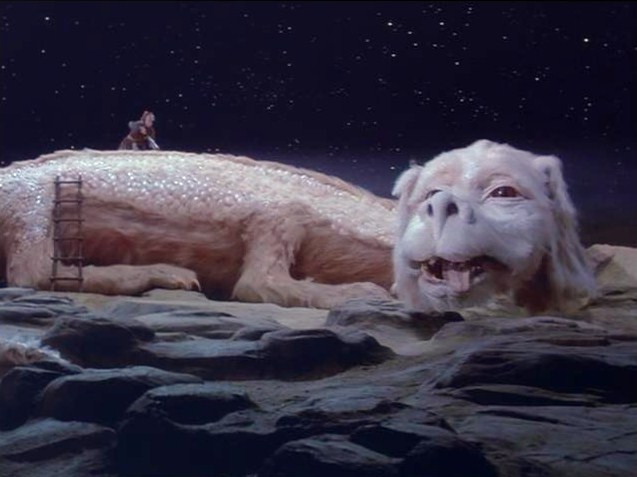
-- Falkor


To be fair, he doesn't really look all that much like most people's idea of a dragon. In fact, Falkor the Luckdragon -- from the Neverending Story books and films -- is unusual in a number of ways.

Covered in fur and scales, Falkor is wingless but still capable of flying. He can breathe fire (the flames are blue), but his most magical trait is his boundless good luck. He's there to help story heroes Atreyu and Bastian on their quest to save Fantasia, and his luck never seems to fail them.


-- Temeraire


This "alternate history" series posits a highly unusual "what-if" -- what if there were dragons during the era of the Napoleonic Wars?  

In Naomi Novik's Temeraire series, dragons not only exist, they also comprise the aerial fleets of European and Asian nations. Captain William Laurence of the HMS Reliant finds himself forced into Britain's Aerial Corps alongside his dragon, Temeraire (who he names after a French ship of the same name). Laurence and Temeraire -- the latter of whom turns out to be a highly unusual kind of dragon -- quickly find themselves caught up in the politics and intrigue of their time, making this historical fiction with a highly fantastical twist, indeed. This original series has been on my reading list for years.


-- Secoh


Secoh merits a place on this list simply because he's a favorite of mine. He appears in Gordon R. Dickson's Dragon Knight series, which centers on the adventures of Jim Eckert. Jim is just your average twentieth-century financially-struggling historian -- until he's whisked back in time to medieval days and promptly finds himself surrounded by magicians, sandmirks, talking wolves, and dragons.

One of those dragons is Secoh, a "mere-dragon" who's only half the size of the average dragon. Half-starved and constantly bullied, Secoh is a sniffling, cowardly sort of dragon -- at least until the wise old dragon Smrgol gives him something new to think about:

"Don't give me this nonsense about being only a mere-dragon! Mere's got nothing to do with what kind of dragon you are. You're a DRAGON! Get that straight, once and for all time! And a dragon ACTS like a dragon, or he doesn't act at all!"

That's good advice, I think, for any dragon to follow.


Friday, January 11, 2013

Traitors

Mr. Arnold


"Traitor!"  It is, perhaps, one of the worst crimes to be branded with. In Dante's epic poem Inferno, the ninth and deepest circle of Hell is reserved for traitors. The term is given to anyone who turns against their friends, their country, or their cause. Throughout history, traitors have been reviled and scorned for their flaws of swinging loyalties and false convictions.

But in fiction, things work a bit differently. There is, after all, nothing like a good fictional traitor. A treacherous character can add conflict, drama, and high stakes to a story in a way few other plot devices can. I happen to love a good fictional betrayal in stories, myself; it makes things so deliciously personal.

So in celebration -- or perhaps condemnation -- of Benedict Arnold's 272nd birthday this Monday, let's take a look at some of the biggest and "best" traitors from the page and screen.


-- Iago


In Shakespeare's Othello, the title character is a general in the Venetian army. While Othello has a perfectly trustworthy officer in the form of his lieutenant, Cassio, Othello makes the terrible mistake of choosing the ensign Iago as his right-hand man.

Iago's still upset that Cassio got promoted over him, and quickly plots a way to get Cassio demoted. The plan quickly escalates, however, and Iago ends up destroying more than a few lives -- including his own. 


-- Mordred


Most people know the legend of King Arthur, the leader who set up the utopian kingdom of Camelot. He ruled over Camelot with the help of his Knights of the Round Table (including his right-hand man, Sir Lancelot) -- with his queen, Guinevere, at his side. Unfortunately, Guinevere and Lancelot got along a little too well, and their inadvertent treachery brought about the fall of Camelot and of Arthur himself.

I say "inadvertent," however, because Lancelot and Guinevere certainly never intended to fall in love and bring about the destruction of Arthur's utopian kingdom. In most versions of the legend, the real, intentional blame for that downfall lies instead in the hands of Mordred. Usually portrayed as Arthur's illegitimate son (from before his marriage to Guinevere), it is Mordred who orchestrates the discovery of Lancelot and Guinevere's secret affair -- and who turns the Knights of the Round Table, and the people of Camelot, against the unhappy couple, ushering in a civil war for control of the kingdom. Mordred's aim was always to take over as ruler of Camelot, but Arthur defeats him -- if at a price.


-- Lando Calrissian


The administrator of Cloud City, Lando Calrissian was first introduced in Star Wars: The Empire Strikes Back as an old friend of Han Solo's. Han and Princess Leia have traveled to the city looking for help from Lando -- only to have it revealed that Darth Vader had reached Cloud City first. Lando (out of desperation, rather than deception) had reluctantly agreed to help Vader lay a trap for the Rebellion duo, and their capture by Vader ultimately leads to Han Solo being so famously frozen in carbonite.

Fortunately, Lando goes on to have a change of heart after Vader goes back on his word about the fate of the prisoners. Lando not only helps to break free the very people he helped imprison; he eventually joins the Rebel Alliance and plays a part in the destruction of the second Death Star. Talk about redeeming yourself!


-- Dennis Nedry


I've been a Jurassic Park fan for twenty years -- ever since it was first released to theaters!  So, as a fan, I can't help but appreciate Dennis Nedry, without whose help the genetically recreated dinosaurs populating a theme park "zoo" would never have escaped. Which, y'know, was a great development for us viewers, as loose dinosaurs + resourceful humans = great popcorn flick.

Of course, for the characters of Jurassic Park themselves, Nedry did few favors. Furious with park owner John Hammond over the myriad responsibilities he faced as the park's primary computer programmer -- and the low pay that went with the job -- Nedry sabotaged the park by shutting down computer systems and electrical fencing. (He also stole some unhatched dino embryos on his way out.) 

However, one can't argue that Nedry didn't pay for his misdeeds: he was eaten by one of the very dinosaurs he'd set free. Let that be a lesson to us all that treacherous behavior rarely pays!


-- Captain Barbossa


If it's possible to have a "favorite" traitor, then Captain Barbossa is mine. Introduced in the first Pirates of the Caribbean film as the villainous pirate captain of the Black Pearl, he eventually is revealed to be more than a pirate: he's also a traitor. Previously the first mate on the Pearl, Barbossa led a mutiny against the ship's then-captain, leaving said captain marooned on a deserted island and taking the ship (and its crew) for his own.

The captain Barbossa betrayed was, of course, Jack Sparrow -- the piratical hero of the Pirates of the Caribbean films. Jack swore revenge against his mutinous first mate (and even achieved that revenge for a time). But, as the films went on, the one-time friendship between the two pirates was eventually, if somewhat grudgingly, renewed. They eventually reached a point where the two could work together -- so long as their goals happened to coincide, that is.


-- Severus Snape


He seemed bad from the beginning. This Harry Potter character was a professor at Hogwarts, teaching Potions classes to the young witches and wizards who dared enter his classroom. Cruel, arrogant, and always smirking -- plus a former employee of the Big Bad himself, Voldemort -- Snape seemed destined to prove himself to be a bad apple. (Harry Potter himself suspected Snape of foul play from the beginning.) But it wasn't until the sixth book in the series, when Snape killed a major Good Guy and defected to join Voldemort once more, that Harry's six-year suspicions were proven.

Or -- were they?  Snape's full story isn't revealed until the end of the seventh and final book in the series, when we learn that things, as they so often are in Harry Potter, were more complicated than what they first appeared to be. Snape, I suppose, may be definitively branded a traitor ... but you might be surprised to see which side he ultimately betrayed.


-- Saruman


J.R.R. Tolkien's good-wizard-gone-bad may just tie with Mordred as Greatest Fictional Traitor of All Time, even if you're not particularly a fan of the high fantasy epic trilogy Lord of the Rings. 

It's hard to argue the case. Saruman started off as the chief of the wizards in Middle-earth, but eventually -- corrupted by the One Ring and by the Dark Lord Sauron himself -- betrayed his fellow wizards and his mission. He was instrumental in bringing about the war on Middle-earth, and, if that wasn't enough, would go on to turn against Sauron, too. (Not, mind you, because he was re-aligning himself with the good guys; rather, his plan was to take over from Sauron and rule Middle-earth himself.)

He is eventually overthrown and defeated, but not before proving himself to be on no one's side but his own. Which, much like Mordred, might be the very definition of the ultimate traitor.


(Luckily for us, such characters makes for great storytelling.)


-- Post by Ms. B