Showing posts with label bestsellers. Show all posts
Tuesday, December 13, 2011
"And Then What Happened?" - Part I: Solving the Mystery Of Edwin Drood
I'm a big Michael Crichton fan. Jurassic Park was the first "grown-up" novel I ever read, which I'd been inspired to pick up because I'd fallen completely in love with the movie version when it was released. The "Jurassic Park" movie was the Star Wars of my generation, a film which became a smash-hit primarily because it was absolutely unlike anything we had ever seen before.
I'd been as wowed as the rest of the world by the lifelike "dinosaurs" of the film version. But Crichton's original book enchanted me in a different way: I was captivated by the way Crichton wrote his sci-fi. With stories about time travel and artificial intelligence, it's true that -- at quick glance -- Crichton's sci-fi devices aren't much different from what you'd encounter in a typical episode of Star Trek. What always made Crichton's sci-fi writing unique, to me, was the way he'd take the scientific advancements of the day and push them a few fictional steps forward. There was scientific reasoning behind his cloned dinosaurs -- and, while scientists will point out that his fictionalized scientific process wouldn't quite work, the science of Crichton's work still always holds some basis in reality. It makes for fascinating reading.
So I was crushed when Crichton passed away three years ago at the age of 66. He left behind a completed manuscript hidden in the recesses of his computer hard drive (Pirate Latitudes) -- and an unfinished techno-thriller about microbiology and nanotechnology.
This unfinished novel was about a third of the way completed, with notes, outlines, and extensive research on the rest of the story also left behind. This led to Crichton's publisher approaching author Richard Preston with a request: to finish the last two-thirds of Crichton's final novel according to the notes Crichton had left behind. Which led to the publication of Micro.
Which leaves me, as a Crichton fan, with one very important question: do I read a Crichton book that isn't really by Crichton?
Micro is not the first time that fans of a particular author find themselves trying to decide if they want to read the next chapter in a story when that chapter's been written by someone else. From Douglas Adams to Robert Jordan, from Robert B. Parker to Frank Herbert, dozens of popular authors who have died before penning the official "end" of their current project have had their novels and series finished out or continued on by someone else. (This is a somewhat different phenomenon from the "pastiche," which is a topic we'll be getting to in the next entry.) And, as you might expect, reactions of fans and critics alike can be -- at best -- mixed.
Often, fans find it more reassuring if the new writer picking up the reins of the story has been approved by the original author. Anne McCaffrey had already handpicked her son, Todd, to continue writing her Dragonriders of Pern series before she passed away. Robert Jordan, author of the popular Wheel of Time series, did not choose his successor -- but Harriet, Jordan's wife and editor, did. Having an author-approved (or relative of the author-approved) replacement often goes a long way towards quelling fans' doubts about the newcomer's ability to produce a worthy sequel.
And, of course, as the saying goes, your mileage may vary. Eoin Colfer was already well-known as the author of the hugely popular Artemis Fowl young adult series when he was commissioned to write another book in the classic science fiction series The Hitchhiker's Guide to the Galaxy. The Hitchhiker's Guide series -- books best described as being science fiction comedy -- is a cult classic of stories that started life as a radio comedy broadcast that Adams only later turned into a series of novels. (In keeping with typical Hitchhiker's Guide logic, Adams's five-book series is often referred to as the "Hitchhiker's trilogy.")
While it's true that Adams had always intended on writing a sixth book in the series, he hadn't left behind a half-finished manuscript or a pile of notes and outlines for Hitchhiker's Guide. (Adams did leave behind an unfinished manuscript, but it was for the Dirk Gently book The Salmon of Doubt, which was eventually published in its fragmented form.) Contrast that with Robert Jordan, who left behind complete outlines and copious notes for his Wheel of Time series that replacement author Brandon Sanderson could faithfully follow. This might explain why Jordan's fans felt more satisfied with Jordan's replacement than Adams's fans felt towards Adams's own (as measured by reviews left at Amazon.com and Goodreads.com). Jordan's fans at least have the reassurance that Sanderson is taking the story in a direction the original author not only approved of, but came up with himself. While any Hitchhiker's fan, if choosing to read And Another Thing..., is left with the question: "Is this really a Hitchhiker's book?"
So. Should "replacement" authors be brought in to finish a popular series if an author passes away before the books are completed? Or should creative works be left alone once their creator is gone?
The answer, of course, will always vary from fan to fan, both for book series and for stories beyond the printed page. (Plenty of Trekkies will swear that Star Trek actually got better after the passing of original series creator Gene Roddenberry.) Whether it's a good idea to continue the story beyond what the original creator created is a question fans will debate back and forth forever ... or as long as publishers and production studios keep bringing in newcomers to keep the old stories going.
As for me, I tend to be mistrustful of books that have been finished up or continued on by someone other than the original creator. It's more than outlines and plot points that make up my favorite reads -- it's the life and personalities the author breathes into the characters, and the themes each author touches on, and the style of the writing itself. Those are things I don't think can easily be recreated, no matter how much a newcomer-writer may love the original author's work.
Still, all the same -- I may give Micro a try. I'm intrigued enough by the premise to give a whirl. But then again, that particular book isn't so close to my heart. If Richard Preston ever writes another Jurassic Park book, I'm afraid I'll definitely be out.
-- Post by Ms. B
Thursday, December 1, 2011
DragonLady
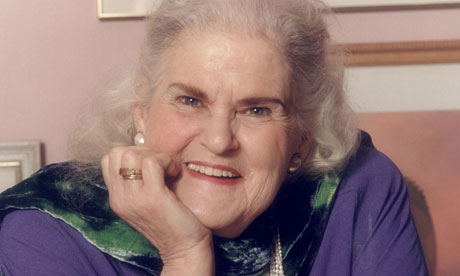
Before Christopher Paolini and Eragon, there was Anne McCaffrey and the dragonriders of Pern.
In 1967, Analog magazine published the novella Weyr Search. The novella would eventually serve as the basis for McCaffrey's first Pern book, Dragonflight -- kicking off a series that includes over 20 novels and two short story collections. Weyr Search tells the story of Lessa, a young woman living on the colonized planet of Pern, who is picked by the dragonriders to be a Candidate for the new queen dragon. If she's chosen (by the dragon, not the riders) to actually become a rider herself, she'll become the most powerful person on the planet, telepathically bonded to a queen dragon who is virtually unstoppable. And yet, it's a dangerous time to be the only queen rider on Pern, because something is returning to the skies ... something that only the dragonriders can stop ...
McCaffrey said that she came up with the idea for the Pern series by asking herself, "What if dragons were the good guys?" Before McCaffrey, the dragons in most fantasy and sci-fi series followed the model of J.R.R. Tolkien's Smaug, the dragon (and evil antagonist) of The Hobbit. McCaffrey was one of the first modern authors to imagine a world where dragons were the heroes instead of the villains. But it wasn't just dragons that benefited from the "good press" they received in McCaffrey's science fiction tales.
Weyr Search would give Anne McCaffrey the distinction of being the first woman to win either a Hugo or Nebula award (which are awards given to authors of science fiction and fantasy). She'd win both, in 1968, for the novella. (Author Kate Wilhelm also won a Nebula that year for her short story The Planners.) But in addition to presenting dragons in a positive light, McCaffrey also brought another rarity of the time to her sci-fi stories: strong female characters.
With characters like Ripley from the Alien films, Sarah Connor from Terminator, and Dana Scully from The X-Files, it's easy to forget that engaging, well-developed female characters are still a relatively new phenomenon in the fictional worlds of sci-fi. And in the late 60s, such characters appeared far less frequently. But in her stories of Pern, as well as in books like The Ship Who Sang and Crystal Singer, McCaffrey presented female characters that were strong, capable, flawed, changing, and -- above all -- human. Rightly known for her inventive story devices (read more about the "brainships" in The Ship Who Sang) and skill at worldbuilding (her world of crystal singing being almost as engaging as Pern), she's also beloved as a writer for her characters. In a time when few were writing about female characters as anything but shallow stereotypes, McCaffrey tried to write her female characters as real people -- and she succeeded.
When I was in high school, I was a big McCaffrey fan, and a huge Pern nut. Looking back on it now, it's not hard to see why McCaffrey's dragon stories appealed so much to me (and to millions of other fans; McCaffrey's books routinely topped the best-seller lists). Who wouldn't want a super-intelligent dragon as their best friend? There's always an element of cool escapism to sci-fi and fantasy, and just as readers of J.K. Rowling's Harry Potter series might imagine the fun of being a wizard, McCaffrey's intricately-detailed sci-fi worlds offer a similar window of imagination.
And yet, like all great sci-fi and fantasy, McCaffrey's stories go beyond mere escapism. Take away the unicorns and dragons, and you're left with intently human stories about characters who are struggling to overcome obstacles and help each other. McCaffrey's worlds are about escapism, but her characters inspire her readers. To young female readers in particular, the Pern books provide characters to both relate to and admire, in a field where such characters were once severely lacking.
McCaffrey passed away last week at the age of 85, but Pern will continue on, both in the novels she wrote and in the Pern stories still being written by her son Todd McCaffrey. And her fans -- myself included -- will remain grateful for the wonderful worlds she took us to.
-- Post by Ms. B
Tuesday, November 8, 2011
"Amazing things do happen, I know, but always to someone else ..."
Today marks the release of Inheritance by Christopher Paolini. It's the fourth and final novel in Paolini's young adult fantasy series, which began in 2003 with the blockbuster book Eragon.
Even if you're not a fan of fantasy books -- or young adult novels in general, for that matter -- you've probably heard about Paolini, who garnered national attention for being fifteen years old when he started writing the book Eragon. Home-schooled (and finishing his high school courses at age 15), Paolini wrote Eragon and then had the book published by Paolini International, his parents' publishing company. To promote Eragon, he toured dozens of schools and libraries, talking to audiences about writing -- and about his book.
While people were reading Eragon, the book would probably not have seen the popularity that it did had the stepson of author Carl Hiaasen not picked up a copy from a Montana bookstore (where Paolini lives). Hiaasen's stepson read the book and loved it, prompting Hiaasen to bring the book to the attention of a major publishing house, Alfred A. Knopf. Knopf promptly published the book the following year, and Eragon would go on to become a national best seller, bringing on three more books (Eldest and Brisingr, as well as Inheritance) and even a film adaptation.
Some praise the Inheritance series as an epic tale by an author whose talent belies his years. Others say the series relies too heavily on plot points seemingly derived from Star Wars and Lord of the Rings. But regardless of opinion, there's no denying the accomplishment of a best-selling teenage author -- though, surprisingly enough, Paolini was hardly the first.
The Young Visiters: or, Mr. Salteena's Plan by Daisy Ashford.
That misspelled title is not a typo. It is, instead, the work of Ashford, who wrote her amusing classic about life for the upper crust in nineteenth century England ... when she was just nine years old. The book was originally published with a forward by J.M. Barrie, and was enjoyed as such a satiric work of wit that many accused Barrie of having written it himself. Daisy Ashford was a real person, however, and she really did write this novella on her own -- along with several other works, before retiring from writing in her teens.
Amelia Atwater-Rhodes
Atwater-Rhodes was only fourteen when she published her first novel, and as since gone on to publish a book every year. She was writing about teens and vampires five years before the first Twilight book was released, and is known for her independent main characters and the strong fantasy elements in her novels.
Gordon Korman
I've been a fan of Korman -- and of Jeremy Bloom, Korman's middle-school poet character -- for years. What I didn't know is that Korman completed his first book at the age of 12, as part of an English assignment, and was published when he was 15. I wonder now if Ms. Terranova, the put-upon English teacher of The D- Poems of Jeremy Bloom, might not be based on the real-life teacher who apparently helped inspire Korman to become an author.
Zlata's Diary, by Zlata Filipovic.
Everyone knows Anne Frank, a teenage girl who kept a diary of her experiences in Amsterdam during the Holocaust, hiding with her family from the Nazi occupation. While Zlata Filipovic's story has a far happier ending than that of Anne Frank's, Filipovic has been called "the Anne Frank of Sarajevo," as she used her diary to record her experiences living in wartorn Sarajevo. Her diary is a fascinating, heartbreaking look into the life of an average teenager trying to live as normal a life as she can in a world torn apart by war.
Don't Get Perconel With a Chicken by H. Allen Smith.
Not all young writers' work ends up on the best-seller list. Still, you should check out this hilarious collection of poems, short stories, letters, and vignettes, all written by kids and teens. (Be sure to check out the limerick summing up the entire myth and legend of King Arthur.)
-- Post by Ms. B
Wednesday, June 29, 2011
The Paris Wife
If you read this and enjoyed it, you might also enjoy these titles. And if you haven't read The Paris Wife yet, you might want to take a look at some of these while you wait for your copy to come in.
Biographies of Hadley Richardson
Hadley, The First Mrs. Hemingway by Alice H. Sokoloff
Hadley by Gioia Deliberto
Books about the "Lost Generation"
Sylvia Beach and the Lost Generation: A History of Literary Paris in the Twenties and Thirties by Noel Riley Fitch
Fiction
Clara and Mr. Tiffany by Susan VreelandHoping to honor his father and the family business with innovative glass designs, Louis Comfort Tiffany launches the iconic Tiffany lamp as designed by women's division head Clara Driscoll, who struggles with the mass production of her creations.
Loving Frank by Nancy HoranFact and fiction blend in a historical novel that chronicles the relationship between seminal architect Frank Lloyd Wright and Mamah Cheney -- from their first meeting, when they were each married to another, to the clandestine affair that shocked Chicago society.
The Women by T.C BoyleRecounts the life of Frank Lloyd Wright as told through the experiences of the four women who loved him: the Montenegrin beauty, Olgivanna Milanoff; the passionate Southern belle, Maud Miriam Noel; the spirited Mamah Cheney, tragically killed; and his young first wife, Kitty Tobin.
Gatsby's Girl by Caroline PrestonA historical novel based on the life and times of Genevra King, F. Scott Fitzgerald's first love and muse, which reflects on what her life would have been if she had chosen the writer instead.
The Master by Colm Tói
bÃnNineteenth-century writer Henry James is heartbroken when his first play performs poorly in contrast to Oscar Wilde's "The Importance of Being Earnest," and struggles with subsequent doubts about his sexual identity.
Wednesday, June 22, 2011
What to Read Next?

Trying to figure out what to read next? A bestsellers list is a great way to find new titles.
So which is the best list for you? I'll give a brief description of what each has to offer, and then you can decide for yourself.
The list we post focuses on fiction and non-fiction in hardback, but they also include paperback, ebook, graphic novels and many other categories on their website. These lists are based on sales from a variety of vendors, including independent book stores, online retailers, newsstands, university book stores and even grocery stores.
This list is compiled from many of the same type of resources that the New York Times uses. The big difference in their list is that USA Today puts all the titles together in one big list, although it is possible to sort it by different genres.
It's very similar to the New York Times list but also includes best-selling audiobooks.
This list compiles the best-selling books as reported by independent book stores (yes, they still exist!). These are also broken down by adult or children, fiction or non-fiction and hardback or paperback.
CBA:
These are the top-selling books as reported by Christian book stores. They also provide different types of lists -- including music and video, along with audiobooks.
These lists are all great ways to find that next book to read. Once you have picked a title or two, you can go to our website and search our catalog to request a copy. Since these are best-sellers there may be a long wait for some of these titles. But don't despair! Starting soon, we are going to post some "readalikes" -- lists of different book ideas that are similar to current best-sellers. But in the meantime, check out these lists and see what interests you. Happy Reading!
Thursday, March 17, 2011
Staff Recommendation #1: "Life" by Keith Richards

Staff Review by B. Kendig
Keith Richards's new autobiography does not disappoint. This 564-page tome, with 32 pages of photographs, is witty, self-deprecating, and, at times, poignant. There is, for instance, the phone call he receives when he's about to go on-stage, with the news that his 3-month-old son, Tara, had just died. Through such memories, we fans get a glimpse into the real Keith, who has always been my favorite Rolling Stone.
He writes a lot about his family and early years. One vignette depicts how he and his aunt would sing "When Will I Be Loved?" together (which also happens to be my favorite Everly Brothers song). Goodness, he and I would have so very much to talk about if ever we sat down for a chat! The book also tells of his first great romance with Ronnie Spector in Detroit, his mercurial relationships with group founder Brian Jones and Mick Jagger, and, of course, Anita Pallenberg, already a movie star in her own right when she met the band -- and his American wife Patti Hansen.
He is unapologetically still the quintessential "bad boy." For any scholar of the Sixties, "Life" is a must-read.
Request "Life" by Keith Richards, with James Fox
Request the Large Print version of "Life"
Request the Audiobook of "Life"
Tuesday, November 16, 2010
Mystery vs. Thriller -- what's the difference?

In a true mystery novel, the murder or action has already taken place and the rest of the story is devoted to finding out who-done-it and why. Motivation is part of the puzzle; and most of the action takes place in the mind of the protagonist. Often, the villain remains unidentified until the very end, while characters are developed and the lead sleuth gains important psychological insights into all the suspects.
By contrast, a suspense novel is one in which the action or crime is yet to happen. The reader is led to the climax as tension rises continuously. Often the reader knows exactly who is going to perform the anticipated event -- without knowing exactly when, where, or how it will occur.
When in doubt as to how to classify a book -- Mystery or Suspense -- we take our cues from the author’s reputation or the publisher’s recommendation. For example, The Girl with the Dragon Tattoo by Stieg Larsson has elements of both mystery and suspense. By applying all the criteria, we have placed this entertaining novel in our Mystery Section. Check it out on your next visit!
Wednesday, October 27, 2010
New York Times Bestsellers List October 24, 2010
Click on title or book cover to request title from Monroeville Public Library. Many are also available in audiobook and large print.
FICTION
1. Reversal by Michael Connelly
2. Fall of Giants by Ken Follett

3. Freedom by Jonathan Franzen

4. The Girl Who Kicked the Hornet's Nest by Stieg Larsson

5. Safe Haven by Nicholas Sparks

6. Squirrel Seeks Chipmunk by David Sedaris

7. Don't Blink by James Patterson

8. Painted Ladies by Robert B. Parker
9. Promise Me by Richard Paul Evans
10. The Help by Katherine Stockett

NON-FICTION
1. Obama's Wars by Bob Woodward

2. Earth (The Book) by Jon Stewart

3. Trickle Up Poverty by Michael Savage
4. The Roots of Obama's Rage by Dinesh D'Souza

5. Assholes Finish First by Tucker Max

6. At Home by Bill Bryson
7. Pinheads and Patriots by Bill O'Reilly

8. Washington: A Life by Ron Chernow
9. The Moral Landscape by Sam Harris
10. The Grand Design by Stephen Hawking

FICTION
1. Reversal by Michael Connelly
2. Fall of Giants by Ken Follett
3. Freedom by Jonathan Franzen
4. The Girl Who Kicked the Hornet's Nest by Stieg Larsson
5. Safe Haven by Nicholas Sparks
6. Squirrel Seeks Chipmunk by David Sedaris
7. Don't Blink by James Patterson
8. Painted Ladies by Robert B. Parker
9. Promise Me by Richard Paul Evans
10. The Help by Katherine Stockett
NON-FICTION
1. Obama's Wars by Bob Woodward
2. Earth (The Book) by Jon Stewart
3. Trickle Up Poverty by Michael Savage
4. The Roots of Obama's Rage by Dinesh D'Souza
5. Assholes Finish First by Tucker Max
6. At Home by Bill Bryson
7. Pinheads and Patriots by Bill O'Reilly
8. Washington: A Life by Ron Chernow
9. The Moral Landscape by Sam Harris
10. The Grand Design by Stephen Hawking
Tuesday, October 19, 2010
New York Times Bestsellers List October 17, 2010
Click on title or book cover to request title from Monroeville Public Library. Many are also available in audiobook and large print.
FICTION
1. Fall of Giants by Ken Follett

2. Don't Blink by James Patterson

3. Freedom by Jonathan Franzen

4. Safe Haven by Nicholas Sparks

5. Squirrel Seeks Chipmunk by David Sedaris

6. The Girl Who Kicked the Hornet's Nest by Stieg Larsson

7. Naked Heat by Richard Castle

8. Legacy by Danielle Steel

9. Bad Blood by John Sandford

10. The Help by Katherine Stockett

NON-FICTION
1. Obama's Wars by Bob Woodward

2. Earth (The Book) by Jon Stewart

3. Assholes Finish First by Tucker Max

4. The Roots of Obama's Rage by Dinesh D'Souza

5. The Grand Design by Stephen Hawking

6. Pinheads and Patriots by Bill O'Reilly

7. Operation Dark Heart by Anthony Shaffer

8. Sh*t My Dad Says by Justin Halpern

9. Even Silence Has An End by Ingrid Betancourt

10. Crimes Against Liberty by David Limbaugh
FICTION
1. Fall of Giants by Ken Follett
2. Don't Blink by James Patterson
3. Freedom by Jonathan Franzen
4. Safe Haven by Nicholas Sparks
5. Squirrel Seeks Chipmunk by David Sedaris
6. The Girl Who Kicked the Hornet's Nest by Stieg Larsson
7. Naked Heat by Richard Castle
8. Legacy by Danielle Steel
9. Bad Blood by John Sandford
10. The Help by Katherine Stockett
NON-FICTION
1. Obama's Wars by Bob Woodward
2. Earth (The Book) by Jon Stewart
3. Assholes Finish First by Tucker Max
4. The Roots of Obama's Rage by Dinesh D'Souza
5. The Grand Design by Stephen Hawking
6. Pinheads and Patriots by Bill O'Reilly
7. Operation Dark Heart by Anthony Shaffer
8. Sh*t My Dad Says by Justin Halpern
9. Even Silence Has An End by Ingrid Betancourt
10. Crimes Against Liberty by David Limbaugh
Subscribe to:
Comments (Atom)