Showing posts with label william shakespeare. Show all posts

Wednesday, April 23, 2014

Birthday Bard


This year, April 23rd marked the 450th birthday of William Shakespeare -- or, at least, marked the day when the world chose to celebrate it. (The Bard was born in 1564, but his exact day of birth remains a mystery.)

We don't know much about William Shakespeare. (I recommend Bill Bryson's excellent biography Shakespeare: The World as Stage, for as comprehensive a look as one can take at the famous playwright.) One thing, however, we can be certain about: his stories, characters, and poetry remain as popular, relatable, and relevant today as they did over four centuries ago.

So in honor of the Bard's big day, I'm here to recommend some personal Shakespearean favorites.


Comedy: Much Ado About Nothing


"There is a kind of merry war betwixt Signior Benedick and [Beatrice]: they never meet but there's a skirmish of wit between them."

In Shakespeare's time, the word "nothing" -- pronounced as noting -- was also used to refer to gossip and hearsay. It's an appropriate reference for a story that follows the paths of two couples who have their worlds turned upside-down by the power of rumor. But it happens in two very different ways: while young Claudio is tricked into leaving his beloved Hero standing at the alter, the more worldly Benedick and Beatrice are tricked into the discovery that their feelings for one another run more deeply than expected.  For both couples, however, happiness is an obtainable goal -- but it will take work, wit, and some outside help for everyone to find their way.


One of the most recent versions of the play was directed by Joss Whedon (creator of Buffy the Vampire Slayer and Firefly, as well as the director of Marvel's blockbuster film The Avengers). But I'll always be partial to Kenneth Branagh's 1993 release, in which Branagh (who directs the film) plays Benedick opposite Emma Thompson's Beatrice.

-- Request Joss Whedon's Much Ado About Nothing
-- Request Kenneth Branagh's Much Ado About Nothing


Runner-Up: The Tempest


Try this 2010 production, which stars Helen Mirren in the traditionally male role of Prospero. A sorcerer, Prospero uses magic (and some old-fashioned manipulation) to conjure a storm and bring about the downfall of Antonio (Prospero's treacherous brother) -- while restoring Prospero's daughter, Miranda, to her rightful inheritance.

-- Request The Tempest


History: Henry IV, Part 1


"I'll so offend, to make offence a skill;
Redeeming time when men think least I will."

Coming-of-age stories are particular favorites of mine. So I was bound to enjoy 1 Henry IV -- which, despite its name, is the first of three Shakespearean plays that focus on the character of Prince Hal (who will himself go on to become King Henry V of England).

The first part of Henry IV shows us a prince who has gained a reputation for himself as a bungling slacker (his father, King Henry IV, informs his court that he rather desperately wishes Prince Hal was not actually his son). But Hal always has the intention of shaping up once the chips are down -- despite the machinations of Falstaff, Hal's mentor, who hopes to keep the prince exactly as he is.

Hal joins his father on the battlefield in the play's final act, the two fighting to defeat a challenge to Henry IV's throne (a throne that will, after all, one day be Hal's). For some great battle sequences -- and truly fine acting -- look no further than this 2012 release from the Hollow Crown series, featuring Jeremy Irons, Tom Hiddleston, and Simon Russell Beale.

-- Request Henry IV, Part 1


Runner-Up: Richard II


I'm partial to last year's staged version from the Royal Shakespeare Company, starring David Tennant (of Doctor Who fame) in the title role. It'll be released to DVD next month; in the meantime, try the version from the Hollow Crown set, starring Ben Whishaw as the vain, selfish king whose overthrow and downfall is as necessary as it is heartbreaking.

-- Request Richard II


Tragedy: Othello


"O, beware, my lord, of jealousy; 
it is the green-eyed monster which doth mock the meat it feeds on."


I've got a soft spot for Othello, my first-ever Shakespeare play. Othello is a general in the Venetian army; Iago is one of his trusted soldiers and a right-hand man. But not quite "right-hand" enough to suit Iago himself -- and when Othello promotes Cassio over Iago as his new lieutenant, Iago decides then and there to take his revenge.

What follows is a story spinning out from the machinations of one of the most evil villains in all of literature. What makes Iago so chilling (and so undeniably brilliant) is his skill in using half-truths to spin the worst lies imaginable -- lies which come to sound all the more convincing and plausible.

Jealous himself of Cassio's promotion, Iago turns jealousy into a weapon wielded against those around him. Iago may be the catalyst, but what makes the play a tragedy is that Othello ultimately becomes his own worst enemy, allowing jealousy to manipulate him as deftly as Iago himself does. The 1995 version, starring Laurence Fishburne and Kenneth Branagh, remains my favorite adaptation.

-- Request Othello


Runner-Up: Hamlet


If it wasn't for Othello, there's no question in my mind that Hamlet would be my favorite of the tragedies. The world seems to agree: it's probably the most popular of all of Shakespeare's plays, and definitely one of the most-often performed. Take your pick!

-- Request a version of Hamlet


Sonnet: Number Eighteen (Listen to it read online here)


Shall I compare thee to a summer's day? 
Thou art more lovely and more temperate:
Rough winds do shake the darling buds of May,
And summer's lease hath all too short a date: 
Sometime too hot the eye of heaven shines,
And often is his gold complexion dimm'd; 
And every fair from fair sometime declines,
By chance, or nature's changing course, untrimm'd;
But thy eternal summer shall not fade
Nor lose possession of that fair thou ow'st;
Nor shall Death brag thou wander'st in his shade,
When in eternal lines to time thou grow'st; 
So long as men can breathe or eyes can see,
So long lives this, and this gives life to thee. 


Click here to hear Joss Whedon's version of "Sigh No More," 
a song from the pages of "Much Ado About Nothing."


-- Post by Ms. B 

Tuesday, April 23, 2013

All the World's a Stage

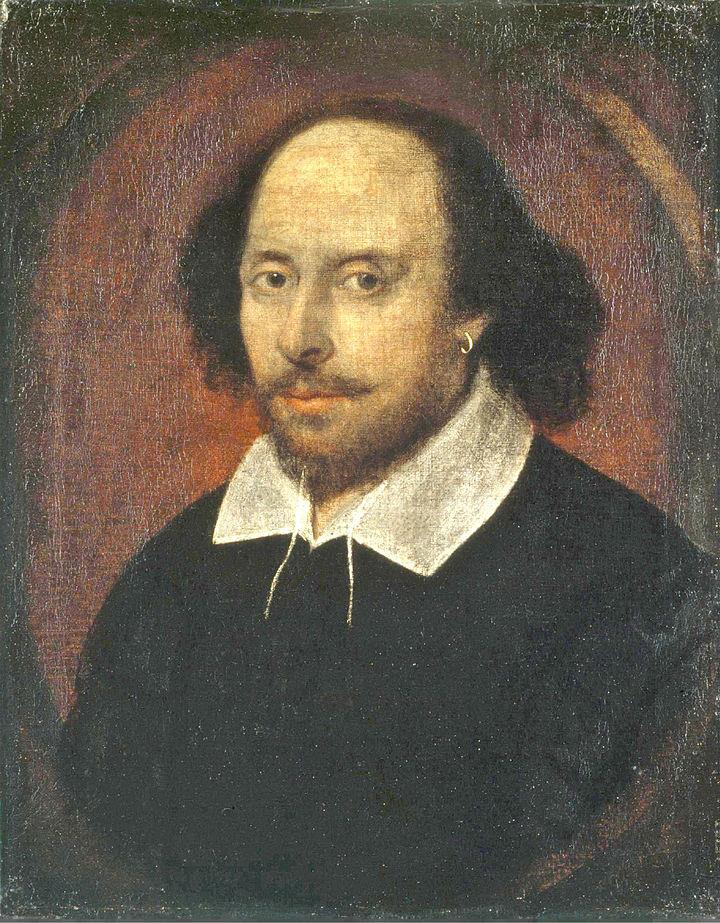
The Chandos Portrait of William Shakespeare. 
(Or not of William Shakespeare. There's some debate. Sort of a lot, actually.)


He's the most famous author in English literature, and yet we know almost nothing about him. We don't know what order he wrote his plays in. We don't know how he actually spelled his name: in the half a dozen signatures he left behind, he never spelled his name the same way twice (and, point of fact, he never actually spelled it "Shakespeare"). We don't know who his friends were, where he traveled (did he ever leave England?), what he was doing when he shot to fame as a highly successful playwright. He left behind almost a million written words, but only fourteen of them are written in his own handwriting. 

April 23 is, by tradition, agreed to be both the day of William Shakespeare's birth (in 1564), and the day of his death (in 1616). While some of that may not be completely accurate -- we're not so sure about that birthday (we just know he was baptized on April 26) -- it has left April 23 as the day to recognize Shakespeare. 

So in honor of the Bard, let's take a look at a few different ways you can experience the stories of William Shakespeare for yourself.


The Droeshout engraving:
 Another portrait of William Shakespeare. Probably. Unless it's not.


Five Ways to Experience William Shakespeare


1. On the Page


Most Shakespeare fans will inform you that Shakespeare is meant to be seen, not read. While that's technically true (plays are written to be performed, after all), there's something to be said for reading the plays on your own -- at your own pace, with your own interpretations. 

Of course, if, like me, you haven't read any Shakespeare since college, the idea of reading and getting some sense out of such dialogue as, "If music be the food of love, play on; Give me excess of it, that, surfeiting, The appetite may sicken, and so die. That strain again! it had a dying fall ... Enough; no more: 'Tis not so sweet now as it was before." -- well, it's a bit intimidating, is what I'm saying.

Enter Simply Shakespeare and Shakespeare Made Easy. These series take the entire, original text of various Shakespeare plays and provide a line-by-line translation into "modern" English. The Shakespeare text is presented on the left-hand pages; the modern version sits across on the right side. It affords you the chance to read the original text -- but, when a particular passage or turn of phrase leaves you baffled, you can look across to the page opposite for a helping hand. (Turns out the above passage -- from Twelfth Night's Duke Orsino -- has the lovesick Duke begging his musicians first to play on, then to stop the music, seeing as he finds music, like love, to change its tune.)


2. With Your iPod


Prefer to experience the Bard through performance?  You might consider trying one of the plays as an audiobook.

Shakespeare's works are all available as audio plays, with your choice of dozens of different full-cast productions for each play. Highly recommended are the Archangel Shakespeare productions, starring A-list Shakespeare actors. Or try Essential Shakespeare Live Encore: The Royal Shakespeare Company in Performance, a "Shakespeare sampler" with key scenes and monologues from various plays, which includes performances by such actors as Judi Dench, Ben Kingsley, Ian McKellen, Jonathan Pryce, Patrick Stewart, and David Tennant.

All these and more are available on cassette tape, CD, and even Playaway. It's the perfect way to experience a Shakespeare play on the go.


3. On the Screen


Of course, it's still a fantastic experience to see a Shakespeare play being performed before your eyes. And the on-screen variations of Shakespeare's plays could take up a blog entry in their own right. Recordings of live performances, modern adaptations and reworkings, movie-star-studded casts, made-for-TV efforts ... the list goes on and on. 

Want Shakespeare adapted for modern times?  Try this loose adaptation of The Taming of the Shrew. Or how about a modernized setting with the original dialogue still in place?  Go with this Royal Shakespeare Company production of Hamlet. Looking for a more traditional presentation?  There's Kenneth Branagh's esteemed production of As You Like It. And, if you'd like to see as "authentic" a version as you can get, try one of the live productions recorded on set at Shakespeare's Globe Theatre in London.

(And, if you'd like to get the full movie-theater experience, check out the Joss Whedon-directed production of Much Ado About Nothing, due out in theaters June 7.)


4. In the Park 


Of course, for the truly ultimate "Shakespeare experience," a live performance is the way to go. And, while we may be a long way from the Globe Theatre in London, Pittsburgh has their very own Shakespearean venue: Shakespeare in the Parks.

Started in 2005, Pittsburgh Shakespeare in the Parks got their start performing As You Like It in Frick Park, as directed by the group's founder, Jennifer Tober. The company of cast and crew grew alongside the performances' popularity, and the group has been offering free performances of Shakespeare plays in Frick, Mellon, and Kennard parks every autumn ever since.

This September, performances of Romeo and Juliet will be running every weekend afternoon. Keep updated on their progress and announcements by checking out their website or following them on Facebook.


5. In Space


We're big fans around here of Doctor Who, the long-running British sci-fi series about the alien Doctor, his human Companions, and his little blue-box spaceship that travels the galaxies through space and time. As a time traveler, the Doctor's met more than his fair share of historical celebrities. And in the third season of the newly-returned show, the Doctor takes his pal Martha for a night out at the theater ... the original Globe Theater, that is, for the premiere performance of Love's Labour’s Lost. Being Doctor Who, it's only a matter of time before the Doctor and Martha end up meeting the Bard himself -- not to mention battling alien witches and encountering Queen Elizabeth I, all while making some truly clever references to Harry Potter.

It's basically the best episode of Doctor Who ever.


Doctor Who isn't the only sci-fi series to make use of Shakespeare references. After hiring esteemed Shakespearean actor Patrick Stewart to play the part of ship's captain, it was probably inevitable that Star Trek: The Next Generation would make good use of quoting the Bard whenever possible. Captain Picard (Stewart) is an avowed Shakespeare fan who keeps a battered copy of The Complete Works of Shakespeare in his ready room, and monologues and plot threads aplenty from the Shakespeare canon have found their way into the series.


Captain Picard's Shakespeare book


From preserved folios to modern adaptions to futuristic references -- it seems that Shakespeare is, indeed, truly timeless. And maybe the reason for Shakespeare's enduring popularity is as much a mystery as the man himself.


Then again, surely it must have something to do with the Bard's unparalleled ability to reveal the timeless truths of what it is to be human. As the Doctor put it: 
"Genius. [Shakespeare]’s a genius -- THE genius. The most human Human that’s ever been."


For more on the life of William Shakespeare, check out Bill Bryson's awesome book 


-- Post by Ms. B

Tuesday, October 25, 2011

About the Classics


This weekend saw the release of the movie The Three Musketeers -- the latest offering in over twenty film adaptations of the classic Dumas tale. Since the early days of motion pictures, Dumas's classic stories of the adventures of Athos, Porthos, Aramis, and D'Artagnan have graced the silver screen in a variety of interpretations and incarnations.

The interpretations are as varied as the filmmakers behind them. There's the silent Douglas Fairbanks version, the classic two-parter with Oliver Reed and Raquel Welch, the fluffy but fun modernized Disney take. (This newest version does appear to be the first adaptation in 3-D. To be fair.)


Dumas joins a cadre of fellow authors -- like Charles Dickens, Agatha Christie, Arthur Conan Doyle, and William Shakespeare -- whose classic works are often adapted for the big (and small) screen. But for every version of A Christmas Carol or Sherlock Holmes that appears -- as adaptations become farther and farther removed from their source material -- it's interesting to go back and look at the original stories ... and their authors.

Read on for a handful of little-known facts about the authors behind some of the biggest-known stories in history (with a particular look at Mr. Dumas himself):

-- Alexandre Dumas suffered from insomnia.

-- It's important to have a hobby: Charles Dickens was interested in hypnotism and conjuring. Lewis Carroll was an amateur photographer; Jane Austen did embroidery.

-- Number of books Dumas wrote in his lifetime: 272.

-- Master of Mystery Agatha Christie went missing for several days in December 1926, shortly after discovering her husband was having an affair. She was found at a health resort in Yorkshire ten days later. (There have been rumors of suicide attempts and amnesia, although the time-travelling science fiction show Doctor Who has the most unique explanation for her disappearance.)

-- Meanwhile, the Master of the Macabre -- Edgar Allan Poe -- is reported to have never started to write until he had completely mapped out his story, setting, and characters. He is also said to have paced back and forth across the room to get revved up before beginning to work.

-- Dumas wasn't just an author; during the 1830 French revolution, he operated as a secret agent, helping to place the Duc d'Orleans on the French throne.

-- It is rumored that Victor Hugo considered calling The Hunchback of Notre Dame "What there is in a bottle of ink" because he penned the last line of the novel with the last drop of ink in the bottle.

-- Dickens doubled as an actor. He is said to have gotten so excited performing his own work onstage that he'd sometimes pass out from overexcitement.

-- There are actually two authors by the name of Alexandre Dumas: Alexandre Dumas pere (father) and Alexandre Dumas fils (son). (The father was the one of Musketeer and Monte Cristo fame.)

-- Hugo wrote his first play when he was only 14.

-- Dumas was once asked to donate 25 francs towards the funeral expenses of a recently deceased bailiff. Not a fan of the office, Dumas apparently tossed over 50 francs and snapped, "There you are -- bury two of them!"

-- H.G. Wells always carried two pens with him, one large and one small. He claimed the big one was for the long words and the little one was for the small ones.

-- William Shakespeare had eleven different ways of spelling his name.

-- Dumas's supposed last words, referring to his unfinished book: "I shall never know how it all comes out now."


-- Post by Ms. B