Showing posts with label birthdays. Show all posts

Tuesday, March 25, 2014

Abracadabra


March 24th was master illusionist Harry Houdini's 140th birthday. In honor of the occasion, allow me to recommend some tales and tricks regarding a few fictional -- and real-life! -- magicians:


1. Now You See Me [DVD]


Four talented magicians have been hired by a shadowy employer to perform a different kind of slight-of-hand: the grandest cat-burgling heists that the world has ever seen. To say more would give away much of the plot-twisting fun of this quirky, unique film -- which ended up being a surprise blockbuster last summer.


2. The Prestige [DVD]


Set in Victorian London, two stage magicians are locked in a bitter rivalry to create the perfect illusion. Enlisting the help of assistants, doubles, and even the engineer Nikola Tesla, the magicians race to unlock each other's secrets -- with horrifying results. Based on the book by Christopher Priest, this film was directed and co-written by the director of the Dark Knight trilogy -- Christopher Nolan.


3. Hiding the Elephant: How Magicians Invented the Impossible and Learned to Disappear by Jim Steinmeyer [NON-FICTION]


The golden age of magicians (1890s-1930s) took place in a time when there was a curious mixing of skepticism and superstition, of science and the supernatural. In this book, Steinmeyer doesn't just reveal the tricks behind the illusions from some of history's best magicians -- he also takes a look at the culture of magic itself. The title is a reference to Harry Houdini, unraveling the "magic" behind his famous 1918 illusion of making Jennie the elephant disappear.


4. Carter Beats the Devil by Glen David Gold [novel]


Set in the "golden age" of magic, this novel stars Carter the Great, a hapless magician who is under suspicion when President Warren Harding turns up dead just hours after appearing beside Carter on stage. What follows is a historical tale that blends mystery, fantasy, and romance, and proved to be a bestseller for the debut author.


5. Half Magic by Edward Eager [novel]


This charming children's book allows four children to become magicians of sorts when they discover a magical charm with the power to grant wishes. There's just one catch: whatever wish you make, it only comes half true. The story is set in the early twentieth century -- but its appeal is timeless.


The Great Illusionist, Harry Houdini


Other magical stories you may like:

-- The Magician's Assistant by Ann Patchett

-- Magic by William Goldman

-- The Magicians by Lev Grossman

-- The Magician series by Raymond E. Feist

-- Jonathan Strange & Mr. Norrell by Susanna Clarke

-- The Night Circus by Erin Morgenstern

-- The Red Necklace by Sally Gardner

-- The Tempest by William Shakespeare

-- The Illusionist [DVD]


-- Post by Ms. B

Wednesday, October 23, 2013

Polka Face


A few months ago, I went to a Weird Al Yankovic concert. Though I'm something of a recent Weird Al fan, it was easily one of the most fun concerts I've ever been to.

There's no denying that "Weird Al" Yankovic is a truly talented musician (listen to "White and Nerdy" sometime, and note how he manages to spit out those rapid-fire lyrics). But a large part of his brilliance can be ascribed to his talent as a song parodist, taking well-known hit songs and giving them his own unique twist -- be it Michael Jackson's "Beat It" becoming "Eat It," James Blunt's "You're Beautiful" becoming "You're Pitiful," or Miley Cyrus's "Party in the U.S.A." becoming "Party in the CIA."

Weird Al Yankovic is a brilliant musician in his own right -- but it's the humor and fun of his parodies that add an extra dimension of awesome to his performances. With October 23rd marking his 54th birthday, it's a good time to recommend some other parodies that are sure to make you smile:


- Robin Hood: Men in Tights


I know, I know -- Mel Brooks's comedic masterpieces are clearly Young Frankenstein and Blazing Saddles. Tough. This one's my favorite.

Besides, when it comes to parodies, this one is the most direct in its target (archery pun intended). While Men in Tights is plenty amusing in its own right, it's best enjoyed if you've first seen the Kevin Costner film Robin Hood: Prince of Thieves. The Costner vehicle was released in 1991, making Brooks's 1993 parody offering a direct response to the original blockbuster.

Starring Cary Elwes as Robin Hood (who rightly noted, "Unlike other Robin Hoods, I can speak with an English accent"), Men in Tights tells much the same story as the original movie it parodies. Robin Hood puts together his band of Merry Men to bring down the evil Prince John and his right-hand man, the Sheriff of Rottingham (whose first name happens to be "Mervin," not that you asked). The beats of the movie more or less follow Prince of Thieves to a T; there's even a bonus cameo of Sir Patrick Stewart, taking on the Sean Connery role of King Richard. How can this not be my favorite?

Request Robin Hood: Men in Tights from the Catalog


- Galaxy Quest


You may have gathered this by now, but I'm a big Star Trek fan. So it was pretty much preordained that I would fall in love with a Star Trek parody this good.

The story centers on a group of actors, who were the stars of the campy sci-fi series Galaxy Quest some twenty years ago. With their show long cancelled, the "crew" find themselves making their living by attending conventions and doing commercials. They snipe at each other -- particularly at Jason Nesmith, who played the captain on the show -- and generally find their lot in life to be a disheartening one. That all changes when a group of real aliens show up. Aliens who are admirers of the show. Aliens who don't have a concept of "fiction" in their society. Convinced that the Galaxy Quest actors are really a crew of space-exploring heroes, the aliens promptly pressgang the actors into helping them defeat an evil alien warlord.

It goes about as well as can be expected.

The Trek parodies are spot on ("Hey, don't open that [hatch]!  It's an alien planet!  Is there air??  You don't know!") But there's a real heart to the story that makes this film more than the sum of its parts. It's a genuine comedy that also has something to say about the nature of science fiction, imagination, and inspiration -- and it remains one of my very favorite films.

Request Galaxy Quest from the Catalog


- Dave Barry's "Fangs of Endearment: A Vampire Novel"


Every once in awhile, ever feel like a favorite author or actor has created something specifically with you in mind?

In his latest essay collection, I'll Mature When I'm Dead, humorist Dave Barry tackles a wide range of topics, from dance recitals to Hollywood to youth sports to colonoscopies. But my favorite chapter is the one entitled "Fangs of Endearment: A Vampire Novel." It's a clear parody of the third volume in Stephenie Meyer's popular Twilight series, Eclipse, and I could only conclude Barry had written it because he knew how much I'd enjoy it:

"The more I thought about it, the more I knew what I had to do: I had to go out into the woods alone. It seemed crazy, like the plot of a bad horror movie where the teenage girl hears a scary noise in the basement, but instead of doing what anybody with an IQ higher than a Chicken McNugget would do, namely sprint out of the house, she goes down into the basement. But I knew I had to do it, because that's what I always do with my trademark stubbornness: I place myself in grave plot peril when there is no coherent reason to do so. Some people may call this ridiculous, but I am guessing that 'some people' have not sold 50 million books to date.

"'I'm tired,' I informed [my father] Pete, yawning with my mouth open for emphasis. 'I think I'll go up to my room now.' I leaned over to give Pete a goodnight kiss, only to trip forward with my trademark heartwarming clumsiness and head-butt him in the temple. He went down like a sack of gravel, out cold on the kitchen floor, eyes open, pupils dilated. I decided it was best to leave him there. I knew that he couldn't do anything anyway. It was up to me. Only me. Me me me me me."

Request I'll Mature When I'm Dead from the Catalog


- South Park, Episode 12.2: "Britney's New Look"


Choosing a favorite South Park parody episode is sort of like choosing a favorite child -- at least for me, a huge South Park fan. But if truly pressed, I'd have to go with "Britney's New Look," an episode which aired in the show's 12th season.

When South Park is at its best (which is often), it becomes more than a showcasing of outrageous jokes and crude humor. Many episodes excel at using parody and farce to make a point, a skill which is put to good use in this episode. When the South Park kids discover that Britney Spears has come to Colorado, they decide to snap her picture and sell it to the tabloids for cash. They sneak into her hotel by claiming to be her children ("It's okay," an excited Britney says on the phone, moments before the boys walk in. "My kids are here. I feel better now.") The boys promptly walk into her room, and Britney's devastation at not seeing her children, and at the relentless media bombardment, give the boys more than they bargained for.

Surprisingly sympathetic to the real Britney Spears (in their own South Park-ian way), show creators Trey Parker and Matt Stone use this episode as commentary on our culture's obsession with celebrity and the preying nature of the paparazzi who surround them. The ending of the episode is a brilliant spoof of Shirley Jackson's classic story The Lottery, with the thrown stones of the original story being replaced by paparazzi camera flashes.

Request South Park: The Complete 12th Season from the Catalog


- "The Saga Begins" - Weird Al Yankovic

There are a lot of beautiful Weird Al parodies. This one just might be the best.


Happy Birthday, Mr. Yankovic!


-- Post by Ms. B

Tuesday, September 11, 2012

A Little Nonsense

Author Roald Dahl is one of those writers of children's books who many adults would insist should not be read by children at all. His fantasy stories -- featuring some of the most Wonderland-esque ideas to ever appear outside of a book by Lewis Carroll -- are populated with dark challenges, dangerous magic, and the most fearsome adults in all of children's literature.

But as any young fan of Dahl could tell you, it is precisely the darkness and fear that make his stories so powerful. By giving his young protagonists frightening, powerful monsters to defeat, Dahl's heroes show readers that they, too, can be expected to triumph over their dragons ... metaphorical or otherwise. (With Dahl, it's always hard to tell; wait until we get to the story about the rhinoceros.)

September 13th marks the 96th anniversary of Dahl's birthday. But before making your very own Bruce Bogtrotter Cake in celebration, let's look back on some of the most weird, wild, and wonderful moments of triumph from Dahl's most celebrated classics.

(Warning: plot spoilers ahead!)


- The Witches' Soup (The Witches)


We know from Harry Potter that there's plenty of good witches out there in the world. But there's also some decidedly evil ones, as in Dahl's book The Witches, wherein it's revealed that not only is the world full of (evil) witches in hiding, but that these Witches are out to destroy all the little kids they can. (Dahl Witches aren't big fans of children, you see.)

Luckily for the (unnamed) young boy who is the hero of our story, his grandma not only knows all about Witches -- she knows how to spot them. Just about anybody can be a Witch in disguise, but our hero's learnt how to spot them, a skill which saves him on more than one occasion. It's not until he and his grandma are on vacation overseas, however, that his Witch-spotting skills are truly put to the test. Not only does he discover that the Royal Society for the Prevention of Cruelty to Children (holding their conference at the very same hotel where our hero and his grandma are staying) is a conference of Witches in disguise, but he also uncovers the Witches' evil plan: to turn all the children in the world into mice.

Unfortunately for our hero, the Witches catch him all the same, and before he knows it, he's been turned into a mouse himself. Luckily for him, he's a talking mouse, and his newfound rodent appearance doesn't stop him and his grandma from implementing a plan to pepper the Witches' conference dinner with their very own mouse-transforming potion. The entire conference, including the Grand High Witch, are all turned into harmless mice -- upsetting the hotel staff (by the sudden appearance of a rodent infestation) in the process.


- A Just-Peachy Escape (James the Giant Peach)


Speaking of Harry Potter ... before the Dursleys, there were Aunt Sponge and Aunt Spiker, who became the guardians of little James after his parents were, well, eaten by an escaped rhinoceros. (These things happen.) Forced to work and slave for his aunts (who refer to him by such affectionate pet names as "you disgusting little beast"), James is able to escape his relatives with the help of some magical crocodile tongues -- which have a peculiar effect on the peach tree outside, causing the tree to grow a fruit the size of a small house. While his aunts make money off of the strange attraction in their front yard, James eventually manages to sneak a look at the peach -- only to find a group of giant talking insects living in the hollowed-out inside. Making fast friends, the not-so-little group of bugs team up with James to escape Aunts Sponge and Spiker, rolling the peach away from the house (rolling it over the house, actually -- sorry, Sponge and Spiker), and off into the world and the start of grand adventures. 

Most fantasy stories starring young and plucky young orphans feature some sort of daring escape from the cruel guardians left behind. But long before Ron and his brothers came in a flying Ford to save Harry from a boring and unfriendly summer with his aunt and uncle, there was Dahl's quite-unique escape for James ... by peach. 


- Veruca Salt and the Squirrels (Charlie and the Chocolate Factory)


Charlie and the Chocolate Factory is less about Charlie Bucket and his delightful trip through the world of Willy Wonka's candy factory, than it is a story about four terrible little children getting their comeuppance. Charlie may be a kind, decent sort of guy himself, but his fellow contest-winners -- Augustus Gloop, Veruca Salt, Violet Beauregarde, and Mike Teavee -- are anything but.

If you know the story, than you know that each child's particular fate hinges on exactly what it is that makes them so uniquely bratty. Mike Teavee, obsessed with television (as his name suggests), finds himself shrunken down to the size of the characters on the TV screen; Violet Beauregarde, champion gum-chewer (and all-around loud mouth), bites into a bad gumball and winds up turned into a giant blueberry. (Yes, a giant, talking blueberry; if you don't like surreal weirdness in your books, Dahl isn't going to work for you.) 

But of all the children, it's Veruca Salt -- the spoiled little heiress of two very rich and very spoiling parents -- who has, perhaps, the best fate. Willy Wonka keeps a large team of squirrels on hand to pick out the good nuts from the bad ones for his candy products. When confronted with Veruca, the squirrels determine that she is, indeed, a bad nut -- and it's into the garbage shoot with her, to join all the other bad nuts (and a few gagging tons of spoiled fish, bacon rinds, old steaks, and liverworst).

And it's not just Veruca who makes a fateful trip down the garbage shoot. After all, as Dahl is careful to point out, it's not really Veruca who is to blame for her spoiled disposition:

"But now, my dears, we think you might
Be wondering –- is it really right
That every single bit of blame
And all the scolding and the shame
Should fall upon Veruca Salt?
Is she the only one at fault?
For though she's spoiled, and dreadfully so,
A girl can't spoil herself, you know.
Who spoiled her, then? Ah, who indeed?
Who pandered to her every need?
Who turned her into such a brat?
Who are the culprits? Who did that?
Alas! You needen't look so far
To find out who these sinners are.
They are (and this is very sad)
Her loving parents, MUM and DAD.
And that is why we're glad they fell
Into the garbage chute as well."


- Bruce Bogtrotter and the Cake (Matilda)


Matilda's eventual defeat of the villainous Trunchbull is certainly an impressive, unforgettable moment, not just in the novel Matilda but from Dahl's stories as a whole. But when it comes to Crowning Moments of Awesome, I still think this chapter might be my true favorite.

At a school assembly, little Bruce Bogtrotter is accused by the Trunchbull of eating a piece of chocolate cake -- from her chocolate cake, a cake baked by the school cook especially for the headmistress herself. Bruce's punishment at first seems too good to be true: he is given an entire chocolate cake then and there at the assembly. There's only one catch: he's got to eat it himself. The whole thing.

Eating an enormous cake by oneself is a surefire recipe for certain dyspeptic disaster. But this is a Dahl book, and in Dahl books, children always win. Bruce rises magnificently to the occasion, and -- with the encouragement of the whole school -- successfully finishes off the whole cake. 

It's not the total defeat of the Trunchbull, but it's an important victory nonetheless. Funny, slightly disgusting, and wholly heartfelt, this scene is quintessential Dahl. After all, it's a scene which proves what Dahl himself so obviously knew: that victory can come about in the oddest of ways.


Check out a complete list of Roald Dahl books here


-- Post by Ms. B

Tuesday, January 17, 2012

Poor Richard


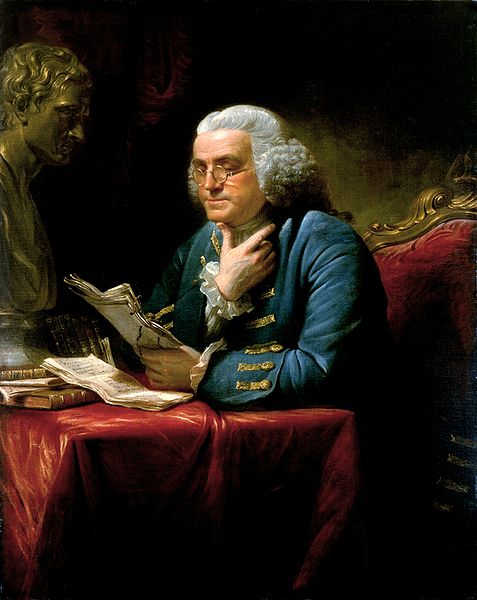
I confess, I'm not particularly a Benjamin Franklin fan. Oh, it's not that I don't like him (because I do), and it's not that I don't think he was a fascinating historical figure (because he was). It's just that, of the Founding Fathers, I happen to have a particular soft spot for John Adams. (The original, that is, not his son.)

But that's just a matter of personal preference -- I'm not knocking Franklin. This Founding Father, who was the oldest delegate at the Constitutional Convention, is rightly remembered not only as a Founding Father -- but as a writer, publisher, inventor, scientist, politician, postmaster, musician, and diplomat, among other duties. He's intriguing for both his myriad accomplishments and his witty personality, making him a figure of fascination both in his own time as well as ours, and in America as well as abroad. My favorite story about Franklin comes from his trip to France, when he traveled to negotiate support for the American Revolutionary War. When he arrived, he found his reputation as a writer and scientist had preceded him. The French admired him, both for his philosophy and his politics -- admired him so much, in fact, that many French people hung his portrait in their own homes. (He'd go on to become "perfectly sick" of having his portrait painted, which he did often at the request of friends.)


You might know Franklin as the inventor of bifocals, the (aptly named) Franklin stove ... and, of course, the lightning rod. (We'll come back to the lightning rod in a bit.) Some of his other experimentations into the fields of science and invention, however, are not always as well-remembered:

-- A frequent traveler, it was Franklin who first proposed that illnesses such as colds and flu may not be caused by exposure to cold and chill air but rather "may possibly be spread by contagion." He noticed his excursions through severe temperatures, suffering cold "sometimes to the extremity only short of freezing," failed to make him sick. He noted that people did, however, often catch cold when spending too much time in close quarters to someone who was already ill, and he became a proponent of good ventilation and fresh air year round.

-- Not only did Franklin recommend exercise as a way to stay in good health, but he was one of the first to put forth the theory that it was more than duration that was important. He suggested measuring exercise not by the length of time it was performed, but rather "by the degree of warmth it produces in the body" -- and by the increase in a person's heart rate.

-- Benjamin Franklin was one of the first people to begin to suspect that there were negative effects from the handling of lead. He began suggesting replacements be made with alternate metals to counteract the "possible" negative effects of lead.

-- He was the inventor of a musical instrument he called the "armonica," which consisted of thirty-seven glass bowls of different sizes attached to a spindle. You played the device the same way bored dinner guests might amuse themselves with their wine glasses -- by pressing on the glass pieces with wet fingers. As goofily fun as it might sound, the armonica proved to be a popular fad: Marie Antoinette took armonica lessons, and music was written for the instrument by both Mozart and Beethoven.

And then, of course, there's my other favorite Franklin story.


Everybody knows about Franklin's famous electrical experiment -- finding a link between lightning and electricity. While many other scientists (like Sir Issac Newton) had suspected a link between the two, Franklin was the first to devise a methodical test to prove that link. Hence, flying a kite with a wire and key attached, hoping to attract a spark.

What's not so well known? Franklin wasn't flying the kite.

It would have looked terrible, had Benjamin Franklin -- a quite respectable figure -- been seen dashing about a field hauling a kite wildly behind him. So he enlisted a little help: his son, William. Yes, it was Franklin's son, and not Franklin himself, who was out in the rain -- and the lightning -- testing the theory.

... well. Family is all about helping each other.


Today, January 17, marks Franklin's 306th birthday. He lived to be eighty-four, and his myriad accomplishments, trades, discoveries, and experiences make him as fascinating a figure as ever. But then again, I may be biased. Much as I love John Adams, I'll always appreciate Benjamin Franklin, first and foremost, as the creator ... of the very first public lending library in America.

(Oh, and don't feel too bad about William Franklin being stuck flying the kite. He was in his twenties at the time -- and he survived the experiment just fine.)


-- Post by Ms. B