Showing posts with label classics. Show all posts

Monday, December 29, 2014

New Year's Resolutions: 2015 Edition


This Thanksgiving, your faithful MPL bloggers had a lot of fun coming up with a list of the pop culture properties that we are most thankful for. But as the holiday season progressed, and we began looking towards 2015, it got us thinking: what other books, films, shows, and music are out there waiting for us to discover?

So we've decided to make a few resolutions. That book we always meant to read?  The films we never got around to watching?  The song Ms. B has always meant to learn to play on the piano?  (More about that in a bit.) This year, we've decided, is the year we tackle such projects.

We now present our official list of New Year's Pop Culture Resolutions for 2015. Wish us luck!

(We'll be back, as the year progresses, to let you know how we do ...)


TRACY'S RESOLUTIONS: 

- Continue watching Classic Doctor Who


Doctor Who is one of the most popular shows in the world. Its very first episode broadcast over 50 years ago. After a brief hiatus in the 90s, the show returned to television in 2005, and became even stronger and more popular than it had ever been. I have only been watching the rebooted Doctor Who for a few years, but I am a genuine Whovian!

Although I am all caught up on the current show, I have much to catch up on with the classic Doctor Who. If you are not familiar with Doctor Who, it is a show about a time-traveling alien who uses an old English police phone box, known as the TARDIS, as his space ship. Oh, and he's really, really old -- but doesn't always look like it! He regenerates into a different body when his current one is too damaged. So there have been 12 Doctors (or 13, depending on how you count them), each played by a different actor.

Classic Doctor Who covers the adventures of the Doctor through his first eight incarnations. I have watched as many as possible of the first two Doctors, but I've been stuck on the Third Doctor for awhile now. I resolve to continue watching Classic Doctor Who episodes until I am caught up!

Request Doctor Who titles from the Catalog.


- Read a gothic novel


One of my favorite Jane Austen novels is Northanger Abbey. It is a story of Catherine, a young woman who is fascinated by the gothic novels that were so popular in the late 18th and early 19th centuries. This fascination gets her in a bit of a misunderstanding with her new friends.

Jane Austen was a reader of these gothic novels herself and, in Northanger Abbey, she parodies them. Now I want to be able to understand that type of novel better. Several novels were mentioned in Northanger Abbey (known as the "horrid novels"), most notably The Mysteries of Udolpho by Anne Radcliffe. The others are The Italian, also by Radcliffe, and The Castle of Wolfenbach by Eliza Parson.

 I resolve to read at least one, if not all, of these novels!

Request The Mysteries of Udolpho from the Catalog.

Request The Italian from the Catalog.


- Make more geek-related crafts


I love to make crafts for myself and as gifts for my friends and family. Unfortunately, I have not been making as many as I would like. My crafting ability lies mostly in counted cross-stitch, but I am also a decent crocheter. 

Last year I discovered the book Star Trek Cross-Stitch: Explore Strange New Worlds of Crafting. I've already made a few things from it, but I want to make more! And the internet is full of patterns for all kinds of geek-related shows, movies and books. What I really want to make is this Death Star pillow that you see above. It would look great sitting on my couch! So, I resolve to crochet the Death Star pillow in 2015!


Online craft sites to check out:

Geekcrafts and Pinterest are great places to look for geeky craft ideas too.


MS. B'S RESOLUTIONS:


- Read Victor Hugo's Les Miserables


I was a junior in high school when our English Lit class studied the much-beloved musical Les Miserables. Based on the book by Victor Hugo, the musical tells the story of Jean Valjean, a convict imprisoned for nearly twenty years after stealing a loaf of bread for his starving sister and her family. Pursued by the unrelenting police inspector Javert (after Valjean breaks the conditions of his parole), Valjean is soon swept into the events of France's June Rebellion of 1832 (more on that historical event here and here).

I've been a fan of the musical ever since 11th grade, but I've never read the original Victor Hugo novel. Coming in at between 1,200 to 1,400 pages (depending on the edition), and chock-full of historical and political detail, it always seemed like a daunting task -- perhaps too daunting.

But this year, that changes!  I resolve to read Victor Hugo's Les Miserables -- from cover to cover. 

Request Victor Hugo's Les Miserables from the Catalog


- See the '80s Classics


Though I am, technically, a child of the '80s, I was young enough that I missed out almost entirely on the pop culture of the era. And that means I've never watched a number of classic films that came out in that decade.

What films, specifically?  I've had a number of classics on my list for quite some time, including The Goonies, Gremlins, The Breakfast Club, Pretty in Pink, Labyrinth, Footloose, Ghostbusters, Superman II, The Untouchables, Ferris Bueller's Day Off, The Fly, and Beverly Hills Cop.

A list that long seems just a little bit intimidating, though (especially since I've got twelve hundred pages of Les Miserables waiting for me). So I hereby resolve to watch at least five '80s films throughout 2015.

Request The Goonies from the Catalog

Request Pretty in Pink from the Catalog

Request Ghostbusters from the Catalog


- Watch Star Trek: Voyager


I've been a Trekkie since before I can remember. And, happily for me, there's been plenty of different flavors of Star Trek for me to enjoy. As a kid, I loved Star Trek: The Next Generation; while in grad school, I became a huge fan of Star Trek: Deep Space Nine. Over the past few years, director J.J. Abrams's rebooted Star Trek movies have earned a place among my all-time favorite films. I've even started watching the original '60s series.

But for all that, there's one particular Trek that I have no experience with -- and that is Star Trek: Voyager. I've been interested in watching Voyager for years, especially since it remains the only Trek show to have a woman (Captain Kathryn Janeway) in the command chair. But despite hearing about its intriguing premise and great characters, I've never quite gotten around to giving the show a try.

The time has come to remedy this, and so I resolve to watch all seven seasons of Star Trek: Voyager by the end of the year.

(There's still Star Trek: Enterprise to get through, but we'll worry about that in 2016.)

Request Season One of Star Trek: Voyager from the Catalog


- Play the music of Hans Zimmer


Maybe not in quite this fashion.

As I've mentioned, I'm a huge fan of film scores and soundtracks. I'm also a particular fan of the scores of Hans Zimmer, the composer behind such film soundtracks as Interstellar, Pirates of the Caribbean, the Dark Knight trilogy, and Guy Ritchie's Sherlock Holmes. Considering that list more or less comprises my favorite films, it's been a delight to have Zimmer's fantastic and memorable music show up in these movies to help tell their stories.

It also just so happens that I've been playing the piano (to varying degrees of success) nearly all my life. While I haven't been playing much in recent years, I've decided that this is the time to change that.

So, inspired by the works of Hans Zimmer, I resolve to learn to play at least two Zimmer-penned songs on the piano by this time next year. And if I'm successful, I'll upload a video of my performance.

Fingers (and tentacles) crossed!

Request the Pirates of the Caribbean: Dead Man's Chest soundtrack from the Catalog

Request the Sherlock Holmes: A Game of Shadows soundtrack from the Catalog


-- Post by Tracy and Ms. B

Tuesday, December 9, 2014

Honorable Mentions


Charles Dickens is rightly remembered for such beloved classics as Great Expectations and Oliver Twist -- but his most famous work remains A Christmas Carol. First published on December 17, 1843, the story tells the tale of the miserly Ebenezer Scrooge, and the three Christmas ghosts who appear throughout Christmas Eve night to warm his heart -- and save his soul. It's been adapted dozens of time for stage and screen, and has become an undeniable staple of the holiday season.

But did you know that A Christmas Carol wasn't Dickens's only ghost story?  Dickens actually wrote a variety of stories featuring ghosts -- some of which, like The Signal-Man, could be considered outright horror thrillers. (The title character of The Signal-Man works on the railway, and is haunted by a specter who appears before him every time a terrible event is to occur.)

Dickens is not the only author whose own wild success actually overshadowed some of his lesser-known efforts. Here are five more authors whose littler-known works are still undeniably worthwhile:


~ Louisa May Alcott's Thrillers


She's best remembered for writing titles that might now be considered part of the "young adult" genre -- classics like Little Women and Eight Cousins. But Louisa May Alcott wrote several stories for older audiences, usually under the pen name "A. M. Barnard" -- and many of those works were not only thrillers, but stories that dealt with radical issues of nineteenth-century sexism and the constraints of society and culture.

Her most critically-acclaimed work is, arguably, the thriller novella Behind a Mask. The story details the life of Jean Muir, a character with a shady past (she was formerly an actress, a considerably more scandalous profession in the nineteenth century) who has reached her thirtieth birthday still a spinster. And then she finds one last chance to fulfill society's expectations of her: she takes the job of governess in a house with two unmarried sons and one unmarried uncle. She means to adopt the mask of a "little woman" herself -- appearing the perfect example of a polite, respectable young lady (she wins her place as governess with a feigned fainting spell in front of the family) until she ensnares a husband. But Jean's motives are far more clever, and downright manipulative, than what you'd see from the March sisters -- though this may not stop you from rooting for her!

Request Behind a Mask from the Catalog


~ Edgar Allan Poe's Detective Stories


Sherlock Holmes is the name we remember, but C. Ausguste Dupin got there first. While Conan Doyle drew on several inspirations for his Sherlock Holmes character (including his med-school professor Dr. Joseph Bell), he was always quick to praise Edgar Allan Poe for his detective stories that paved the way for Sherlock Holmes. ("Where was the detective story," Conan Doyle once asked, "until Poe breathed the breath of life into it?")

Poe is remembered as the master of horror, but he actually wrote in a wide variety of genres, including science fiction and detective stories. In the latter category, he produced three short stories: Murders in the Rue Morgue, The Mystery of Marie Roget, and my personal favorite, The Purloined Letter. The stories star Dupin, an amateur detective (although the word "detective" had not yet been invented) who assisted the police in a trio of bizarre investigations. He's accompanied in his adventures by our unnamed narrator, who serves as Dupin's closest friend and our window into Dupin's world.

Request the Dupin stories from the Catalog


~ Conan Doyle's Historical Fiction


Most Sherlock Holmes fans already know about Arthur Conan Doyle's love-hate relationship with his most famous fictional creation. While Conan Doyle ultimately seemed to be fond enough of his consulting detective (and also loved writing about the adventures of Professor Challenger in such tales as The Lost World), he always considered his best and most important works to be his historical fiction.

Such historical works include extensively-researched novels like The White Company and Sir Nigel, both set during the Hundred Years' War between the royal houses of England and France. There was also Micah Clarke, a coming-of-age story set in seventeenth-century England that details the religious and political tension of the time; and a series of comical short stories about Brigadier Gerard, a soldier in the French Army during the Napoleonic Wars, who Conan Doyle used to comment on the stereotypes and prejudices that the British and French had for one another.

Request The White Company from the Catalog

Request Sir Nigel from the Catalog

Request Micah Clarke from the Catalog

Request the Brigadier Gerard stories from the Catalog


~ Agatha Christie's Love Stories


Agatha Christie remains the best-selling novelist of all time, beloved for her classic mysteries like And Then There Were None and Murder on the Orient Express, as well as such characters as Hercule Poirot and Miss Marple. But while she has come to be affectionately known as "the Queen of Crime" due to her incredible skills in the mystery genre, she also wrote half a dozen novels of a different sort entirely.

Using the pen name "Mary Westmacott," Christie wrote a series of romance and family stories, referring to them as "bitter-sweet stories about love." The books enjoyed modest success -- much to Christie's delight, as the novels succeeded under their own merits and not due to her name being on the cover (her identity as Westmacott would remain hidden for nearly two decades). She wrote the Westmacott books throughout her life, telling stories that focused not only on romance, but on family relationships between parents and children or between siblings. The results were among the works she was most proud of.

Read an essay about "Mary Westmacott" written by Rosalind Hicks, Christie's daughter

Request Westmacott books from the Catalog


~ Michael Crichton's Medical Thrillers


Before he was a best-selling author of such novels as The Andromeda Strain and Jurassic Park, Michael Crichton was a med student. But while he was earning his MD from Harvard Medical School, Crichton had his first publishing success, writing under the pen names "Jeffery Hudson" and "John Lange."

He published ten mystery thrillers that sold well enough to help pay his way through med school -- no mean feat, as any pressed-for-time med student could tell you. While Crichton viewed them mostly as pulpy entertainment ("I write them fast and the reader reads them fast and I get things off my back," he explained in a 1969 interview), they showcased his skill at engaging characters and tightly-plotted storylines, not to mention a love of research and accuracy. Though Crichton successfully graduated with his MD, it's not surprising to know he turned to writing full-time -- always incorporating his love of science into his stories.

Read more about Michael Crichton's "med school" thrillers

Request A Case of Need from the Catalog


-- Post by Ms. B 

Thursday, July 25, 2013

All For One


I love The Three Musketeers.

That is to say, I love the classic novel The Three Musketeers, by Alexandre Dumas. And, if you've read or seen any version of the story, you'll know that the book is actually about four Musketeers. There's the experienced trio of Athos, Porthos, and Aramis. But there's also the headstrong, determined, quixotic D'Artagnan, who has just left home and family and is on a quest to join the Musketeers.

D'Artagnan first meets his future friends when he makes it to Paris and promptly manages to insult three different people in the space of a few minutes. Each man challenges D'Artagnan to a duel, and D'Artagnan, never one to back down from a challenge (his father told him not to!), schedules the duels back-to-back-to-back. When he arrives at the meeting place for Duel #1, he quickly realizes that the three men he's fighting in turn are all friends -- and that, moreso, they are all Musketeers.

The duels never take place; the four of them become too busy fighting off the Guards of Cardinal Richelieu (who have arrived to arrest them for illegal dueling). D'Artagnan may be young and rash, but he proves his bravery and honor when he assists the three Musketeers in overpowering the Guards. The trio decides to take D'Artagnan under their wings, and what follows is a high-rollicking adventure tale packed with action, intrigue, and broad, sweeping romance.

Dumas would go on to write two sequels to The Three Musketeers: Twenty Years After and Ten Years Later. (The third novel, Ten Years Later, is so lengthy that it's often published as three separate volumes: The Vicomte de Bragelonne, Louise de la Valliere, and The Man in the Iron Mask.) The Three Musketeers and The Man in the Iron Mask remain the most-read works from Dumas's complete "D'Artagnan Romances" cycle, and have inspired numerous stage and film adaptations.


While the D'Artagnan Romances are, of course, historical fiction, it's interesting to note that they were historical fiction even at the time of their publication. The Musketeers' tales are all set in the seventeenth century, but Dumas himself was writing them in the nineteenth, with The Three Musketeers first appearing in serialized installments in 1843. That first novel was written by Alexandre Dumas and a collaborator, Auguste Maquet, a history teacher and fellow author (if one of less acclaim, by far, than Dumas, who was already a celebrated playright when he wrote Musketeers).

Dumas and Maquet did some homework for their tale, and the D'Artagnan Romances are based on a real-life figure. Charles de Baatz d'Artagnan, born in 1623, became the capitaine lieutenant of one of King Louis XIV's two Musketeer companies. He was a lifelong soldier who would go on to be appointed governor of Lille, and he died in battle in Hollan in 1673.

The Memoirs of Charles D'Artagnan were written by another real-life Musketeer (though not, unfortunately, by Charles D'Artagnan himself), and it was these memoirs that served as much of the inspiration for Dumas's novels. The other three Musketeers -- Athos, Porthos, and Aramis -- were also all real-life figures, who receive mention in the D'Artagnan memoirs. How much of these "memoirs" are factual is a matter of some debate, but what's certain is that both D'Artagnan and the Musketeers were figures who really existed.

The Musketeers themselves were formed by King Louis XIII of France, a combination of soldier and personal royal bodyguard. Louis armed his personal guards with a newly developed flintlock, muzzle-loading riffle -- the musket (hence the company's name). The Musketeers of history were variously disbanded and reassembled throughout the next two hundred years by various members of French royalty, before finally being permanently dissolved in the time of Napoleon.


A monument to the Four Musketeers in Southern France


Of course, in the end, the lasting appeal of D'Artagnan and the three Musketeers lies not in their factual history, but rather in what they've come to represent.

From the beginning, the Musketeers have had a glamorous appeal. King Louis XIII was something of a romantic, and he had a fondness for the by-gone days of chivalry. (It's what made him so reluctant to actually enforce any of those anti-dueling laws he kept enacting -- seeing as dueling itself was, in theory at least, a method of "defending one's honor.") The Musketeers themselves were career soldiers who did not include noble blood as an entry requirement to their ranks; you became a Musketeer through your own actions and merits, not by merit of your birth.

Dumas himself seemed entranced by the romantic chivalry of the Musketeers, writing about them two hundred years after their real-life creation. Audiences since then have responded to his books in kind, taking the stories to heart for their action, adventure, and chivalry.

Even in medieval times (where we think of the concept originating), chivalry was generally far more of a theory than a practice. There wasn't much more of it in the seventeenth century. So rather than harkening back to a better, nobler past, D'Artagnan and his friends represent a world of bravery, courtesy, and honor that's never really existed outside the pages of a book.

Or, at least, one that has not existed yet. It's true that the fun and adventure of Dumas's Musketeer tales is undoubtably a primary reason for the stories' staying power. And yet, the ability of story to inspire should never be overlooked. People would not keep reading these books if they did not see some appeal in the ideals of courage, honor, and friendship that Dumas wove throughout his stories. Hopefully, that appeal will prove inspirational to Dumas's readers. The honorable world of the Musketeers may not be in our past -- but perhaps it may be in our future.


Alexandre Dumas, born on July 24, 1802

From the Catalog:

-- The Three Musketeers
-- Twenty Years After
-- Ten Years Later
* The Vicomte de Bragelonne
* Louise de la Valliere
* The Man in the Iron Mask

-- All books by Alexandre Dumas
-- Film adaptations of The Three Musketeers
-- Film adaptations of The Man in the Iron Mask


(non-fiction)

-- D'Artagnan, The Ultimate Musketeer: A Biography by Geoffrey F. Hall and Joan Sanders.
-- Ã‰minence: Cardinal Richelieu and the Rise of France by Jean-Vincent Blanchard.
-- Books on King Louis XIII
-- Books on King Louis XIV


-- Post by Ms. B

Wednesday, May 8, 2013

The Boy Who Grew Up


If you don't know the story of J.M. Barrie, you still know the story of Peter Pan, the Boy Who Never Grew Up. Peter Pan and his crew of Lost Boys, his sidekick Tinker Bell, his arch-nemesis Captain Hook, the mermaids and fairies, the "Indians" and pirates, and the Darling children that he introduces to the world of Neverland -- like Robin Hood and King Arthur, or Odysseus and Hercules, Peter Pan and his story have become a part of our cultural mythology. Even if you've never seen the films, watched the plays, or read the books, you know the name "Peter Pan."

But to look behind the pirates and fairies and see what the classic tale is truly about, you need to know a little bit more about the author behind its creation: J.M. Barrie.

James Matthew Barrie was born on May 9, 1860. His father, a weaver, struggled to support the large family (James was the third son and youngest child). His mother, Margaret, who had a strong interest in literature and art, helped bring about her son's determination to become a writer. Her influence, unfortunately, was far-reaching in other respects: when James's older brother, David, died in a skating accident at age thirteen, James took is upon himself to help his mother over the loss. When Margaret took to bed for the remainder of her life in grief over the loss of her favorite child, six-year-old James played the part of his older brother -- even wearing David's old clothes -- to try and repair his mother's grief.


James Matthew Barrie


Barrie was only seventeen when his first play was performed: Bandolero, the Bandit, presented at the Dumfries Academy of which Barrie was a student. He graduated in 1882 from Edinburgh University, finding employment first as an editor for the Nottingham Journal, then as a journalist in London. He was a well-financed novelist and playwright by the time he married (his wife was Mary Ansell, who appeared in one of Barrie's plays). It was at about this time that Barrie began taking long walks through Kensington Gardens, and it was there that he met the Davies family: father Arthur and mother Sylvia, and their five children: George, Jack, Michael, Nicholas ... and Peter.

The Davies children became an instant family for the childless Barrie, who spent countless hours entertaining the boys with his games and elaborate stories. (They'd also eventually become his wards, when first Arthur, and then Sylvia, both died at young ages.)

Peter Pan first came to life as part of one such story for the Davies children. The character made his first written appearance within Barrie's novel The Little White Bird, which was published in 1902. Two years later came the release of the three-act play Peter Pan.

The classic play is so much a part of our storytelling history that it's something of a shock to realize how much of a gamble the production truly was. Success was by no mean a given with this elaborately fantastical story of flying actors, dogs and crocodiles, pirates and fairies and shadows. Barrie grew increasingly nervous about several elements of the play -- including the sequence in which Tinker Bell, Peter Pan's fairy sidekick, drinks from a poisoned goblet and dies. Peter then turns to the audience and asks them to clap if they believe in fairies, the sound bringing Tinker Bell back to life. On opening night, Barrie had instructed the orchestra to begin clapping if the audience did not -- but his concern was unwarrented. The audience burst into wild applause, beginning a tradition that continues in performances of the play to this day.


From Arthur Rackham's illustrations for "Peter Pan in Kensington Gardens"


The pop culture portrayals of films like Finding Neverland, as well as our own understanding of the myth of Peter Pan, make it tempting to see J.M. Barrie himself as the model for the Boy Who Never Grew Up. But it's also been noted that Barrie gave his eternally youthful hero the name of one of his charges. Barrie reserved his own first name to share with a different character: Captain James Hook. Captain Hook's injury -- his missing right hand -- may have been given in reference to the crippling pain Barrie experienced in his own right hand (a condition which was exacerbated by his time spent writing). 

And Captain Hook's greatest enemy may have been a reference to Barrie's own. It's not just any crocodile which remains in eternal pursuit of Hook -- it's a crocodile that has swallowed a clock. Hook is forever chased by Time itself -- a fitting metaphor, perhaps, for Barrie's own view on the tragedies of mortality.


The Peter Pan statue in Kensington Gardens


The story of Peter Pan is thought of as a children's tale, but that is not, perhaps, quite right. The story, while whimsical and fantastic, has a darker element. Peter Pan, the Boy Who Never Grew Up, is an almost tragic figure: so consumed with thoughts of himself, he cares for no one else. Indeed, he not only cares for no one else: the effects of Neverland mean that he cannot remember anyone else. (Wendy and her brothers must continually remind Peter who they are, as it continues to slip his mind.) Peter may live eternally youthful, but Barrie himself seems to understand that never growing up would be more of a curse than a blessing.

Still, the whimsical world he created for Peter and the Lost Boys remains, for most of us, a symbol of the innocence, fun, and magic of childhood. Neverland seems destined to remain such a symbol for centuries to come. "And thus it will go on," wrote Barrie himself, at the end of his novel, "so long as children are gay and innocent and heartless."


Dustin Hoffman as Captain Hook and Robin Williams as Peter Pan


Books:

The Annotated Peter Pan - The original text by J.M. Barrie, with notes and annotations all about the classic story.

Capt. Hook: The Adventures of a Notorious Youth by J. V. Hart - The childhood of James Hook!

Peter and the Starcatchers by Dave Barry and Ridley Pearson - A fun, action-packed prequel series to the original novel.

Peter Pan in Scarlet by Geraldine McCaughrean - The "authorized" sequel to the original story. 

Muppet Peter Pan - The Muppets meet Peter Pan in this fun and kid-friendly graphic novel adaptation.


Films:

Peter Pan, or The Boy Who Wouldn't Grow Up - A classic production of the musical version, starring Cathy Rigby.

Hook - This movie answers the question: what if Peter Pan grew up?  Starring Robin Williams as Peter Pan and Dustin Hoffman as Captain Hook.

Neverland - A miniseries that serves as a prequel of sorts to the traditional story.

Peter Pan - This 2003 film release returns to the stage tradition of having the same actor play both Mr. Darling and Captain Hook. A whimsical, dark adaptation that keeps in the spirit of the novel.

Finding Neverland - Stars Johnny Depp as J.M. Barrie, recounting his meeting of the Davies family and how that meeting led to the story of Peter Pan.


-- Post by Ms. B

Tuesday, April 23, 2013

All the World's a Stage

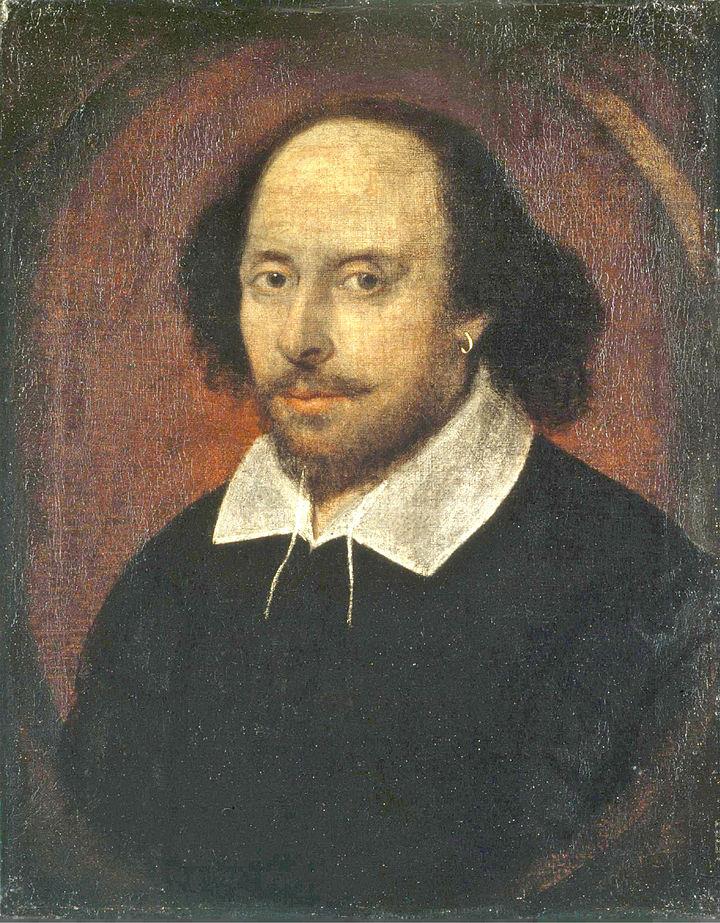
The Chandos Portrait of William Shakespeare. 
(Or not of William Shakespeare. There's some debate. Sort of a lot, actually.)


He's the most famous author in English literature, and yet we know almost nothing about him. We don't know what order he wrote his plays in. We don't know how he actually spelled his name: in the half a dozen signatures he left behind, he never spelled his name the same way twice (and, point of fact, he never actually spelled it "Shakespeare"). We don't know who his friends were, where he traveled (did he ever leave England?), what he was doing when he shot to fame as a highly successful playwright. He left behind almost a million written words, but only fourteen of them are written in his own handwriting. 

April 23 is, by tradition, agreed to be both the day of William Shakespeare's birth (in 1564), and the day of his death (in 1616). While some of that may not be completely accurate -- we're not so sure about that birthday (we just know he was baptized on April 26) -- it has left April 23 as the day to recognize Shakespeare. 

So in honor of the Bard, let's take a look at a few different ways you can experience the stories of William Shakespeare for yourself.


The Droeshout engraving:
 Another portrait of William Shakespeare. Probably. Unless it's not.


Five Ways to Experience William Shakespeare


1. On the Page


Most Shakespeare fans will inform you that Shakespeare is meant to be seen, not read. While that's technically true (plays are written to be performed, after all), there's something to be said for reading the plays on your own -- at your own pace, with your own interpretations. 

Of course, if, like me, you haven't read any Shakespeare since college, the idea of reading and getting some sense out of such dialogue as, "If music be the food of love, play on; Give me excess of it, that, surfeiting, The appetite may sicken, and so die. That strain again! it had a dying fall ... Enough; no more: 'Tis not so sweet now as it was before." -- well, it's a bit intimidating, is what I'm saying.

Enter Simply Shakespeare and Shakespeare Made Easy. These series take the entire, original text of various Shakespeare plays and provide a line-by-line translation into "modern" English. The Shakespeare text is presented on the left-hand pages; the modern version sits across on the right side. It affords you the chance to read the original text -- but, when a particular passage or turn of phrase leaves you baffled, you can look across to the page opposite for a helping hand. (Turns out the above passage -- from Twelfth Night's Duke Orsino -- has the lovesick Duke begging his musicians first to play on, then to stop the music, seeing as he finds music, like love, to change its tune.)


2. With Your iPod


Prefer to experience the Bard through performance?  You might consider trying one of the plays as an audiobook.

Shakespeare's works are all available as audio plays, with your choice of dozens of different full-cast productions for each play. Highly recommended are the Archangel Shakespeare productions, starring A-list Shakespeare actors. Or try Essential Shakespeare Live Encore: The Royal Shakespeare Company in Performance, a "Shakespeare sampler" with key scenes and monologues from various plays, which includes performances by such actors as Judi Dench, Ben Kingsley, Ian McKellen, Jonathan Pryce, Patrick Stewart, and David Tennant.

All these and more are available on cassette tape, CD, and even Playaway. It's the perfect way to experience a Shakespeare play on the go.


3. On the Screen


Of course, it's still a fantastic experience to see a Shakespeare play being performed before your eyes. And the on-screen variations of Shakespeare's plays could take up a blog entry in their own right. Recordings of live performances, modern adaptations and reworkings, movie-star-studded casts, made-for-TV efforts ... the list goes on and on. 

Want Shakespeare adapted for modern times?  Try this loose adaptation of The Taming of the Shrew. Or how about a modernized setting with the original dialogue still in place?  Go with this Royal Shakespeare Company production of Hamlet. Looking for a more traditional presentation?  There's Kenneth Branagh's esteemed production of As You Like It. And, if you'd like to see as "authentic" a version as you can get, try one of the live productions recorded on set at Shakespeare's Globe Theatre in London.

(And, if you'd like to get the full movie-theater experience, check out the Joss Whedon-directed production of Much Ado About Nothing, due out in theaters June 7.)


4. In the Park 


Of course, for the truly ultimate "Shakespeare experience," a live performance is the way to go. And, while we may be a long way from the Globe Theatre in London, Pittsburgh has their very own Shakespearean venue: Shakespeare in the Parks.

Started in 2005, Pittsburgh Shakespeare in the Parks got their start performing As You Like It in Frick Park, as directed by the group's founder, Jennifer Tober. The company of cast and crew grew alongside the performances' popularity, and the group has been offering free performances of Shakespeare plays in Frick, Mellon, and Kennard parks every autumn ever since.

This September, performances of Romeo and Juliet will be running every weekend afternoon. Keep updated on their progress and announcements by checking out their website or following them on Facebook.


5. In Space


We're big fans around here of Doctor Who, the long-running British sci-fi series about the alien Doctor, his human Companions, and his little blue-box spaceship that travels the galaxies through space and time. As a time traveler, the Doctor's met more than his fair share of historical celebrities. And in the third season of the newly-returned show, the Doctor takes his pal Martha for a night out at the theater ... the original Globe Theater, that is, for the premiere performance of Love's Labour’s Lost. Being Doctor Who, it's only a matter of time before the Doctor and Martha end up meeting the Bard himself -- not to mention battling alien witches and encountering Queen Elizabeth I, all while making some truly clever references to Harry Potter.

It's basically the best episode of Doctor Who ever.


Doctor Who isn't the only sci-fi series to make use of Shakespeare references. After hiring esteemed Shakespearean actor Patrick Stewart to play the part of ship's captain, it was probably inevitable that Star Trek: The Next Generation would make good use of quoting the Bard whenever possible. Captain Picard (Stewart) is an avowed Shakespeare fan who keeps a battered copy of The Complete Works of Shakespeare in his ready room, and monologues and plot threads aplenty from the Shakespeare canon have found their way into the series.


Captain Picard's Shakespeare book


From preserved folios to modern adaptions to futuristic references -- it seems that Shakespeare is, indeed, truly timeless. And maybe the reason for Shakespeare's enduring popularity is as much a mystery as the man himself.


Then again, surely it must have something to do with the Bard's unparalleled ability to reveal the timeless truths of what it is to be human. As the Doctor put it: 
"Genius. [Shakespeare]’s a genius -- THE genius. The most human Human that’s ever been."


For more on the life of William Shakespeare, check out Bill Bryson's awesome book 


-- Post by Ms. B

Monday, January 28, 2013

200 Years of a Universal Truth


It is a truth universally acknowledged, that a single man in possession of a good fortune must be in want of a wife.

This is one of the most famous opening lines of any book in the English language. In a single sentence, Jane Austen set up everything that would follow in her now-famous classic, Pride and Prejudice. P&P is one of the most beloved books of all time. Its enduring popularity (along with all things Austen) continues to grow in a way that I'm sure the author could never have imagined.

Jane Austen published six novels, but none as well known as Pride and Prejudice. The characters of Elizabeth Bennett and Mr. Darcy, and their love story, continue to endure.


Why does it endure? Pride and Prejudice is my favorite novel, so for me it's more than just the love story between the two main characters. It's also the subtle commentary on the social mores of Jane Austen's day. Austen had a keen eye for irony and had the ability to showcase all of the different personalties that made up her world. I think that we all recognize people that we know in her characters. Times and customs may change, but we still all know someone like Mr. Darcy, who thinks he is far superior than most of the people around him. And there are still women (and men) who are outrageous flirts like Lydia Bennet. We may not have to worry about whether someone would ever want to marry us because of our social standing, like the Bennet sisters do -- but we all look for someone to share our lives with, just like they did.

Pride and Prejudice was the second of Austen's six published novels. And while everything she has ever written has been read and scrutinized many times, the problem for most fans is that she only wrote these six novels and a few unfinished stories. With the immense popularity of the BBC miniseries of Pride and Prejudice in 1995, the world's obsession for more exploded. Sequels, spin-offs, modern updates, and even a graphic novel have been published in the last 18 years. There is even a book with Mr. Darcy as a vampire!

To honor the 200th anniversary (January 28, 1813) of the publication of Pride and Prejudice, here are a few of the sequels and spin-offs of Pride and Prejudice (and even some books regarding our ever-lasting love for Jane). But only a few. Any more than that would require you to spend more time reading about them than actually reading them!

[For any Janeites out there who are interested, the Jane Austen Society of North America, Pittsburgh Region, will be having its 2013 Jane Austen Festival on March 15 and 16. For more information, check out the group's website.]


-- Pride and Prejudice (Graphic Novel) by Nancy Butler
This is one of my favorite versions of the novel. It's so much fun! It tells the story very accurately and the illustrations are beautiful.

-- Pride and Prejudice and Zombies by Seth Grahame-Smith
Elizabeth Bennet and her sisters as zombie hunters? In this adaptation, they are. There is still the love story of Elizabeth and Mr. Darcy, but with zombies attacking the countryside, we see a whole different side of the famous novel.

-- Mr. Darcy's Daughters by Elizabeth Aston
In this sequel, we meet the five daughters of Elizabeth and Darcy. It has been twenty years since their wedding. The Darcy sisters have much in common with the Bennet sisters, with their widely different personalties. Appearances are also made by several loved (and not-so-loved) P&P characters.

-- Pride and Prescience by Carrie Bebris
Here we have Elizabeth and Darcy, newly married, acting as a crime-solving duo. Not long after Caroline Bingley has married a rich American, strange things begin happening. Since these odd occurrences involve the Bingleys, the Darcys step in to figure out what is going on. The first in a series of mysteries.

-- Darcy's Story by Janet Aylmer
Pride and Prejudice is told primarily from Elizabeth's point of view. The only time we, as readers, get to know what Darcy is thinking is when he writes a letter to Elizabeth to explain his relationship with Mr. Wickham (among other issues). In this novel, we get the whole story from Darcy's perspective.


-- Jane and the Unpleasantness at Scargrave Manor by Stephanie Barron
The first in a delightful mystery series where we see the Jane Austen many of us believe she was -- smart, observant, and resourceful. The stories are supposed to be long-lost diaries of Jane herself. In each one, we find Jane involved in helping a friend or family member, proving their innocence in some crime. We even get a chance to see Jane have a little bit of romance with a mysterious Lord!

-- Jane Bites Back by Michael Thomas Ford
In this series, Jane Austen is now a vampire and has been for 200 years! She is now living in upstate New York and owns a book store. The last novel she wrote before becoming a vampire has been rejected 116 times by publishers, while her books and all of the sequels and spin-offs fly off the shelves of her store. Although she has kept a low profile all these years, she is suddenly thrust into the spotlight, and a mysterious person from her past has come to complicate her life.


-- Jane's Fame: How Jane Austen Conquered the World by Claire Harman
Harman examines the many ways that the popularity of Jane Austen has grown all over the world, and why we are still so fascinated by Austen's books and her life.

-- All Roads Lead to Austen: A Year Long Journey with Jane by Amy Elizabeth Smith
Does everyone love Jane Austen? Even in countries where the culture is very different from that of Regency (or even modern) England? Smith decides to find out when she takes a year to read Austen's novels, in Spanish, with book-loving friends throughout several Latin American countries.

-- A Jane Austen Education: How Six Novels Taught Me About Love, Friendship, and The Things That Really Matter by William Deresiewicz
For a nice change, we have a look at Jane Austen from a male perspective. Deresiewicz discusses how each of Austen's six novels influenced his life and helped him become the man he is today.


Happy Reading!


-- Post by Tracy