Showing posts with label staff picks. Show all posts

Thursday, December 18, 2014

Staff Recommendation #38 -- "The Grand Budapest Hotel"


Films from director Wes Anderson are not to everyone's liking. Until recently, they weren't completely mine either. They've slowly been growing on me and his latest, The Grand Budapest Hotel has made me a convert!

Wes Anderson is a darling of the indie film world with his unique storytelling style. Since his days as a student at the University of Texas, he's been making films; many with his good pal Owen Wilson. Their first collaboration was on a short film called Bottle Rocket (1994) which did well enough at the Sundance Film Festival that they turned it into a full length film which was released in 1996.

Minor successes followed with Rushmore (1998), The Royal Tenenbaums (2001), The Life Aquatic with Steve Zissou (2004) and The Darjeeling Limited (2007). He started getting even more critical and audience attention with the animated Fantastic Mr. Fox (2009) and Moonrise Kingdom (2012).


His latest film, The Grand Budapest Hotel, stars Ralph Fiennes in one of his finest performances. He plays M. Gustave, the concierge of the Grand Budapest Hotel, the finest and grandest hotel in Eastern Europe just before the start of the Second World War. He is well loved and respected by the guest and co-workers alike. Young Zero, the new lobby boy, comes to Gustave's attention and he takes the young man under his wing. Gustave plans on grooming Zero to be his successor some day.

Before that can happen, Gustave ends up in jail for the murder of a rich and titled widow who was quite found of Gustave. He must rely on Zero and Zero's girlfriend Agatha, the town baker's assistant, to free him. What follows is a mad cap and zany adventure of jail breaks, shoot outs and a wild race down a ski slope in a sleigh.


Family is a recurring theme in any Wes Anderson film, and this film is no exception. Gustave and Zero form a tight family unit, although more like brothers than father and son. This bond will help them through a few tight spots.

I don't claim to understand the technical aspects of making a film, but I know a unique vision when I see one and Wes Anderson sure has it. An Anderson film has a visual style all its own. He intertwines many different film making techniques into almost everyone of his films, such as stop motion animation, which is used frequently in The Grand Budapest Hotel.

I have to admit I'm not very familiar with Anderson's early films. I started to become a fan with Fantastic Mr. Fox and my admiration for his uncommon way of telling a story has continued to grow. The Grand Budapest Hotel, has made me a firm fan of Wes Anderson.


Request The Grand Budapest Hotel [DVD] from the Catalog.

Request Bottle Rocket [DVD] from the Catalog.

Request Rushmore [DVD] from the Catalog.

Request The Royal Tenenbaums [DVD] from the Catalog.

Request The Life Aquatic with Steve Zissou [DVD] from the Catalog.

Request The Darjeeling Limited [DVD] from the Catalog.

Request Fantastic Mr. Fox [DVD] from the Catalog.

Request Moonrise Kingdom [DVD] from the Catalog.


--Post by Tracy


Tuesday, November 18, 2014

Laughter: The Instant Vacation


Despite living in Pennsylvania all my life, I am not a winter person. Of course, I'm hardly alone in that: with below-average temperatures, and sunset falling around 5:30 p.m., it can be hard not to get a bit down as the winter season rolls in.

So what's the best way to beat the winter blues?  Laughter, as they say, can be the best medicine. Read on for some recommendations of my personal favorite comedies -- guaranteed to make the cold dark of winter seem just a little bit brighter.


-- Monty Python and the Holy Grail (1975)


"And there was much rejoicing." Arguably the funniest film outing from the Monty Python comedy trope, the movie's a loose retelling of King Arthur's quest for the Holy Grail. It allows for a marvelous collection of history-flavored skits that cover everything from witch hunts and Black Plague to sword duels and arranged marriages. There's also a song-and-dance number and a Trojan Rabbit. It's really not to be missed.

Request Monty Python and the Holy Grail from the Catalog


-- The Princess Bride (1987)


"Is this a kissing book??" In many ways, The Princess Bride has a similar flavor to Monty Python and the Holy Grail, with the routines taking jabs at fairy tales (instead of history). But the story of The Princess Bride has a stronger structure and gets layered more deeply, letting most of the humor come directly from the characters. The fairy tale plotline is framed as a bedtime story being read by his grandfather to his under-the-weather grandson, giving an additional twist (and plenty of extra humor) to the set-up.

Request The Princess Bride from the Catalog


-- The Emperor's New Groove (2000)


"You threw off my groove!" Kuzco is a spoiled Incan emperor whose royal advisor accidentally transforms him into a llama. Teamed up with a good-hearted farmer (whose house Kuzco was was about to knock down to make way for his new palace), Kuzco has to learn how to find a little humility ... or risk remaining a llama forever. It would be a straight-up buddy comedy if not for the abundance of sight gags, sly references, and snappy dialogue -- making this unusual Disney animated movie a film that borders on satire.

Request The Emperor's New Groove from the Catalog


-- Galaxy Quest (1999)


"By Grabthar's Hammer ... what a savings." Jason Nesmith and his actor pals haven't had a real acting gig since the cancellation of their cult-classic sci-fi series Galaxy Quest. These days, they eke out a living with convention appearances and publicity stunts -- all the while growing increasingly frustrated with Jason, who seems to think he's really as important as his on-screen alter ego, Captain Taggart. But when a group of fans show up who turn out to be literally out of this world, Jason and his Galaxy Quest crew suddenly find themselves in the center of an intergalactic adventure that they're not quite prepared for. You don't have to be a Star Trek fan to appreciate this clear Star Trek satire -- but if you're a Trekkie, this is not one to be missed.

Request Galaxy Quest from the Catalog


-- The World's End (2013)


"Face it, we are the human race and we don't like being told what to do!" When Gary King was in high school, he and his four best friends attempted "the Golden Mile," an infamous pub crawl across their hometown of Newton Haven, England. Now, some twenty years later, Gary's decided to put the gang back together to complete the Golden Mile once and for all. But as it turns out, it's not so easy to go home again -- particularly when your hometown just might be the center of the upcoming alien apocalypse!  The trappings sound like a sci-fi take on The Hangover, but nothing could be further from the truth; instead, it's a delightfully quirky and surprisingly sweet movie that's all about growing up and finding your way out in the "real world" past high school.


-- Post by Ms. B 

Thursday, October 30, 2014

Doing Your Best: The Lessons of Jack Skellington


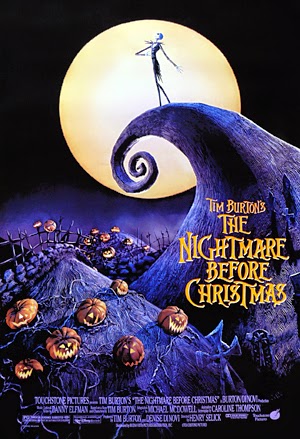
When it comes to family-friendly Halloween classics, it's pretty hard to top The Nightmare Before Christmas. It tells the tale of Jack Skellington, the resident Pumpkin King of Halloween Town -- a city populated by friendly witches, vampires, ghosts, and monsters, whose job it is to create the Halloween holiday each year. As the annual Halloween celebrations wind down to a close, we discover that Jack, while great at his job, is feeling stuck in a rut. Isn't there more to life than the same old chills and thrills?

So Jack can't believe his good fortune when he stumbles onto a magical portal that takes him to the land of Christmas Town. He doesn't exactly understand what it is about the place that makes him feel such a warm and happy glow, but he's eager to share the wonders of Christmas with his fellow Halloween Town citizens. And, before he knows it, he's struck with an even better idea: what if, this year, he takes over the Christmas holiday himself?


After sending Halloween Town's best trick-or-treaters to find (that is, kidnap) Santa Claus from Christmas Town, Jack and his fellow scarers begin putting together their own version of Christmas: spiderweb-decorated Christmas trees, Venus-Fly-Trap Christmas wreaths, and presents that range from zombie rubber ducks to haunted toy dolls. They're convinced their take on Christmas will be the perfect way to improve the holiday -- and that the children around the world will find their surprises frightfully delightful. Unfortunately, sometimes even the most well-meaning of plans don't quite work out ...

Released in 1993, the film was animated with stop-motion techniques; instead of drawings, the characters were sculpted and then posed frame-by-frame to achieve the illusion of animated motion. The movie itself is a musical, with ten songs by composer Danny Elfman framing the backbone of the story. With an original storyline, intricately sculpted sets, and colorful, quirky, wholly engaging characters, it's a beautifully unique movie that is a quirky joy to watch.

While I find the animation bizarrely charming, and the music delightfully catchy, the real heart of the story, for me, lies in the character of Jack Skellington. Because as it turns out, Jack is not just a somewhat surprising Everyman character -- he's also got a truly inspiring lesson lying at the heart of his story.


Sure, he's a skeletal pumpkin king whose job description includes scaring the wits out of people whenever he can manage it -- but it's hard not to relate to Jack's opening lament. Who hasn't grown weary of the daily grind now and again, and found themselves in need of rekindling the enthusiasm they once had for the day-to-day challenges of life?

Jack's delight in discovering Christmas is an easy thing to relate to, too. We can all understand his sudden enthusiasm for this new world, and for the happiness -- inexplicable as he finds it -- that the Christmas spirit gives him. He doesn't understand it, but he loves it just the same.

So you almost cheer him on when he gets it in his skull to take on the holiday himself -- despite all evidence to the contrary that he'll be able to pull it off. It's not just that he doesn't understand how to make Christmas come alive; it's also that he doesn't seem particularly good at it. Still, Jack doesn't let the odds stand in his way. Believing whole-heartedly in what he and his fellows have created, he sets off with a happy heart to bring a Halloweenified Christmas to children the world over.

And he fails abysmally.


The children of the world (not to mention their parents) hate Halloweentown's Christmas gifts. Jack's Christmas flight ends in miserable defeat, and it takes a newly-released Santa Claus to right the chaos Jack has inadvertently created.

His failure doesn't come as a surprise -- not even to Jack himself, once he stops to think it over. The residents of Halloween Town had never quite grasped the concept of Christmas to begin with ("Nobody really understood," he laments to his ghost dog, Zero). Jack himself had struggled to understand Christmas, and as he'd never truly been able to explain it, it's unsurprising that his fellow Halloween citizens didn't get it either. It's only to be expected that Jack's Christmas "nightmare" proves such a disaster.

And yet, despite that failure -- Jack ultimately decides that he's not sorry that he tried. "I did my best!" he exclaims, clearly proud that he "at least ... left some stories they can tell." (Which is certainly true.) Best of all, it was in preparations and celebration of his Halloween-ified Christmas that Jack felt like himself again.

Ultimately, the joy for Jack came not from whether or not he succeeded, but in the attempt itself. And in a world where winning is often held up as the only goal of value, it's a timely reminder that there's worth to be had simply in trying.


And I asked old Jack,
"Do you remember the night
When the sky was so dark,
And the moon shone so bright?

"When a million small children,
Pretending to sleep,
Nearly didn't have Christmas at all,
So to speak?

"And would, if you could,
Turn that mighty clock back
To that long, fateful night --
Now, think carefully, Jack!

"Would you do the whole thing
All over again,
Knowing what you know now,
Knowing what you knew then?"

And he smiled, like the old
Pumpkin King that I knew,
Then turned, and asked softly of me,
"Wouldn't you?"


Happy Halloween!


-- Request the film on DVD from the Catalog
-- Request the film on Blu-ray from the Catalog
-- Request the soundtrack on CD from the Catalog
-- Request the original picture book by Tim Burton from the Catalog


-- Post by Ms. B

Tuesday, October 28, 2014

Staff Recommendation #34: Snowpiercer


I'm a huge fan of post-apocalyptic/dystopian stories and have been for a very long time. My first post-apocalyptic book I can recall reading was Z for Zachariah by Robert C. O'Brien, which is about a young girl who seems to be the sole survivor of a nuclear accident, until one day a man shows up at her house. I suppose as a young person I was impressed by this young woman, not much older than me at the time, who was surviving on her own in a desolate world. Of course, I've read many more since then, with The Hunger Games trilogy by Suzanne Collins and the MaddAddam trilogy by Margaret Atwood being my favorites.

After watching the recently-released DVD Snowpiercer, I've finally realized what appeals most to me about this genre -- the determination of the human spirit and the will to persevere. There are many other genres that tackle this subject, but dystopian stories resonate with me for some reason. Maybe it's the idea that we hope the future will be bright and shiny-- but here are stories of nuclear destruction, plagues, and war. How did we let this kind of event happen? How can anyone survive such a cataclysmic event?

In the case of Snowpiercer, based on a French graphic novel, the event is a failed attempt to control global warming. Instead of cooling the earth a little bit, it cooled it a whole lot and froze the earth. The lucky few who survive board a train that continually travels the globe, with the wealthy traveling in style and the poor crammed into the last few cars of the train, literally living on top of each other.

There have been several attempts at getting to the front of the train in the 17 years they have been traveling, but they have all failed. Curtis (Chris Evans) is determined to break out and help the rest of those stuck at the back who are eating gelatinous mounds called protein bars. Messages are mysteriously appearing in those bars, but who is sending them and why? With the help of Gilliam (John Hurt), Edgar (Jamie Bell), and many others, they make their break. Will they make it to the front and what will they find if they do?

No matter the circumstances that find humans in a post-apocalyptic situation, they somehow find a way to survive. It may not be a wonderful existence, but they keep battling on, longing for that day when things will get better. While I read and watch, I wonder how I would survive in this kind of world and am constantly amazed by what the people in these stories are willing to sacrifice in order for them and many others to survive. I'm not sure how I would do, but I hope I never have to find out!

Click here to request Snowpiercer [DVD or Blu-Ray].

Click here to request Snowpiercer [graphic novel].

--Post by Tracy


Tuesday, May 6, 2014

The Play's the Thing


It goes without saying that plays are written to be performed. And yet, there's a certain enjoyment to be had in reading a play's script for yourself, rather than viewing it as a performance. When you read a play, you become, in a sense, the director -- casting the roles, choosing the pacing, and finding your own interpretation of what the story has to say.

Here are four recommendations of plays that -- in my opinion, at least -- have a particular magic all of their own ... even when they're only on the printed page.


Inherit the Wind


Written by Jerome Lawrence and Robert Edwin Lee, Inherit the Wind is a fictionalized version of the 1925 Scopes "Monkey" Trial. Bertram Cates, a small-town high school teacher, is placed on trial for teaching the theory of evolution in violation of state law. His lawyer is Henry Drummond, a famous defense attorney who finds himself pitted against his former friend and fellow lawyer, Matthew Harrison Brady, in a courtroom battle that rocks not just the town, but the entire country.

Loosely based on real-life lawyers Clarence Darrow and William Jennings Bryan, the play takes place primarily in the courtroom. Though the themes focus on family, politics, and intellectual freedom, the ending makes it clear that the moral of the story is that science and religion are not only conflicts that can co-exist peacefully -- but that they don't have to conflict at all.

-- Click here to request Inherit the Wind


The Miracle Worker


When Helen Keller was not quite two years old, she contracted an illness that left her both blind and deaf. This fictionalized (though well-researched) account by William Gibson shows Helen's struggles as a six-year-old child cut off from communication to the outside world.

Enter Annie Sullivan, a twenty-year-old governess who suffered herself from problems with her sight. Hired by Helen's parents, Annie was determined to teach the little girl not only discipline and self-control -- but also how to "speak."

Annie taught Helen the American Sign Language alphabet, in order to spell words into Helen's palm. It was, initially, an arduous task, as Helen did not understand the concept of objects each having their own individual name. Angry at her teacher for imposing discipline and structure, Helen fought off Annie's attempts to reach out to her -- until the powerful moment when the idea of words finally clicked into place for Helen, and opened the world to her.

-- Click here to request The Miracle Worker


Waiting for Godot 


First performed in Paris, Waiting for Godot has become a classic of modern theatre -- despite being so unusual and irrational that many audience members attending those early performances left before the play was over. And, in many ways, it's not hard to understand why. The dialogue is oddly patterned. The set is nearly bare. The structure of the play has none of the usual dramatic beats (the second act has a plotline nearly identical to the first); the action is almost nonexistent. 

The play itself concerns two older men, Vladimir and Estragon, who are, as the title suggests, waiting for the arrival of Mr. Godot, who they know is going to save them. At the end of each act, they are reassured by a passerby that Mr. Godot will be coming the following day. 

Not much on action. But the waiting characters spend their time ruminating on the nature of suffering, salvation, repetitiveness, and time itself. Part character study, part philosophical reflection, Samuel Beckett's bleak, stark examination of life is open to a wide variety of interpretations. As Beckett himself said: "I don't know who Godot is. I don't even know (above all don't know) if he exists. And I don't know if they believe in him or not – those two who are waiting for him. All I knew I showed. It's not much, but it's enough for me, by a wide margin."


Amadeus


Peter Shaffer's Amdeus first premiered in London in 1979, to glowing reviews and box office success. (A year after its initial release, people were lining up at six in the morning to buy tickets for that day's performance.) The play offers a fictionalized account of the life of composer Wolfgang Amadeus Mozart, with particular attention paid to his real-life rivalry with Antonio Salieri, the court composer for the Emperor of Austria.

Shaffer first became interested in the two musical rivals after he learned that the circumstances around Mozart's death are a bit murky. Delving into extensive research, Shaffer found no evidence that the real Salieri had murdered his incorrigible (and undeniably more talented) rival -- but the idea for the story wouldn't go away.

The play opens with Salieri as an old man, who makes his confession to the audience about his role in the death of Mozart. He then presents the story as a "flashback" to the audience, in an attempt to fully confess his side as the story. What follows is a tale of jealousy, rivalry, and the best and worst of human nature. As Peter Shaffer himself put it, "The conflict between virtuous mediocrity and feckless genius took hold of my imagination, and it would not leave me alone."

-- Click here to request Amadeus


-- Post by Ms. B 

Tuesday, April 1, 2014

The Feast of Fools

"That, of course, is the great secret of the successful fool -- that he is no fool at all."
~ Isaac Asimov


As April Fools' Day winds to a close, take a look at some recommended reading focused on some of our favorite fictional jesters, jokesters, and fools. They'll be sure to put a smile on your face!


-- Fool by Christopher Moore


Of all of Shakespeare's tragedies, King Lear is one of the darkest. It tells the story of a king who pits his daughters against each other, tearing the family apart as Lear himself slowly spirals into insanity. And the consequences, as one can imagine, are catastrophic.

So was it a stretch for humor novelist Christopher Moore to turn it into a comedy?  It's surprisingly hard to say. Told from the perspective of Pocket, Lear's court jester (unnamed in the original play), Moore spins a tale that blends together elements of King Lear with a number of other Shakespearean stories -- while throwing generous dollops of his own racy and twisted humor into the mix. The result is a bawdy satire that you don't have to be a Shakespeare fan to enjoy (although it won't hurt).

Click here to request from the Catalog.


-- The Queen's Fool by Philippa Gregory


Phillippa Gregory is best known for The Other Boleyn Girl and its sequels, in which she uses her in-depth historical research to imagine the lives of the family, court, and citizens of Tutor England.

In The Queen's Fool, Hannah is a young teen girl from Spain who currently lives on Fleet Street with her father. Disguised as a boy to protect herself, Hannah nonetheless ends up being recognized as having "the Sight" -- that is, the power to see the future. She soon finds herself a member of the court of Edward VI (Henry VIII's son) as the "holy fool." What follows through this fictional character's eyes is the historically-accurate unfolding of the fates of two queens, Mary and Elizabeth, as Hannah herself is trained by the jester Will Sommers -- a real-life historical figure.

Click here to request from the Catalog.


-- Wyrd Sisters by Terry Pratchett


"When shall we three meet again?"
"Well, I can do next Tuesday."

Terry Pratchett has been known and loved for his Discworld series for over thirty years. Starting life as a straight-up fantasy satire, the Discworld series has evolved into an always-hilarious series that -- while still parodying other authors, stories, and genres -- tells fantastic tales in its own right.

Wyrd Sisters, which makes clear nods to the world of Shakespeare, centers on a trio of witches (the naive Magrat, the irrepressible Nanny Ogg, and the stern-and-practical Granny Weatherwax). But there's also the Fool, who has his hands full trying to avoid a destiny he's not entirely certain he's cut out for. When reading Pratchett, the ideas as are much fun as the story itself -- so this is a novel not to be missed.

Click here to request from the Catalog.


-- Hop-Frog by Edgar Allan Poe


Sharing similar themes to The Cask of Amontillado, this short story tells the tale of a court jester who has his own ideas as to what makes rulers great and what makes jesters funny -- and he's determined to open the people's eyes to these truths with his last, and "greatest," jest. To say more would spoil the twists and turns of this horror-filled tale from Edgar Allan Poe, which delivers a surprisingly poignant message on the nature of power and and prejudice.

Click here to request from the Catalog.


-- Mad Love by Paul Dini and Bruce Timm


All's fair in love, war ... and supervillainy. In the world of comic books, the Joker is the constant thorn in Batman's side -- but he's not always alone in his schemes and scams. He's got a right-hand henchwoman to help him out: the jester-like Harley Quinn.

In this classic graphic novel, written by Harley Quinn's original creators, we get the back story into one of the more twisted romantic relationships in comic book history. Formerly a psychiatrist, Quinn's now got her own problems, namely: how to get her best guy to pay a little bit more attention to her and a little less attention on defeating his arch-enemy. The solution seems simple to Harley: it's time to put a stop to the Bat once and for all. Of course, like any good scheme, things don't always go exactly according to plan.

Click here to request from the Catalog.


-- Post by Ms. B

Thursday, September 19, 2013

Really Bad Eggs


September 19th is one of the best days of the year. Know why?

Because it's International Talk Like a Pirate Day, of course!


I've written before about my fondness for pirates, and I know it's an obsession in which I'm not alone. Author and historian David Cordingly once wrote about an exhibit he co-organized at the National Maritime Museum in London. Entitled Pirates: Fact and Fiction, the exhibit first opened in May 1992 and was scheduled to last for four months. Its popularity was such that it remained for three years.

It's probably books like Stevenson's Treasure Island (1883) and Barrie's Peter Pan (1904) that should be heralded (or blamed) for creating pop culture's modern pirate craze. However, the biggest single force in piratical storytelling today is Disney's ongoing film series Pirates of the Caribbean.

When the first movie premiered in 2003, pirate movies had been in a slump for decades. Movies about pirates were known to be box-office duds, and the fact that Disney's latest offering was a quirky fantasy film said to be "based" on one of their amusement park attractions did little to inspire confidence in critics.


But Pirates of the Caribbean: The Curse of the Black Pearl turned out to be a sleeper success, eventually pulling in over $600 million worldwide in ticket sales. The success was enough to spawn three additional movies in the series -- Dead Man's Chest, At World's End, and On Stranger Tides. Together, the series made history as the first film franchise to have two entries in the "billion dollar" club (that is, films whose gross has exceeded $1 at the worldwide box office).

In total, the four movies have brought in over three and a half billion dollars worldwide. In doing so, the films have also widened the world originally created for The Curse of the Black Pearl, bringing in elements of nautical mythology to create a rich, unique universe that rivals Lord of the Rings or Star Wars in terms of epic scope. The films were conceived as summertime popcorn flicks -- but, like the best sagas, they have a richness in story and character that goes far beyond the usual such fare.

Speaking of characters, there's one in particular who can take credit for the breakout success of the Pirates franchise -- and that is Captain Jack Sparrow. You don't have to have seen the movies to recognize the name of Johnny Depp's hilarious, witty, and wholly weird pirate character, as Jack Sparrow has become a pop culture icon in the decade since his first appearance.


Savvy?


Jack's my favorite, of course -- Jack's everyone's favorite -- but he's hardly the only noteworthy character in the story. He's joined by such figures as Will Turner (a young blacksmith whose ideas of right and wrong have convinced him of the impossibility of someone committing a crime but still being a decent human being), Elizabeth Swann (a governor's daughter who idolizes pirates for the freedom they represent), Commodore Norrington (a by-the-books naval officer whose world spins entirely out of his own control), and Angelica (a pirate lady from Jack's past who also just happens to be the daughter of Blackbeard). Alongside such formidable baddies as Captain Barbossa, Lord Cutler Beckett, and the devil of the sea himself -- Davy Jones -- the result is a series of stories where complex characters reign supreme.

Over the course of four films, the Pirates of the Caribbean film series posits questions about the nature of freedom, the line between good and evil, the meaning of love and friendship, and prices that must be paid for what we most want to obtain. The result is a blockbuster franchise of depth and scope that remains my favorite set of films to this day.

Considering the holiday, now would be a great time to watch (or re-watch) the Pirates of the Caribbean films. For those of you short on time, however, I've summed up my five favorite moments of the series for you. Take a look:


5. Entrances

"It's a shilling to tie up your boat to the dock."

Nobody knows how to make an entrance like Captain Jack Sparrow. The character is first introduced in The Curse of the Black Pearl standing tall and proud atop the yard of a regal sailing ship. Except -- as the camera pulls back -- you see that Jack's not aboard a tall ship at all, but rather a tiny (and somewhat hole-ridden) boat that's sinking, more than sailing, its way into port.

This funny, surprising entrance (made all the more entertaining by the character's utter unconcern) was the first indication that there might be something more to this movie than the usual summer blockbuster. Jack's wholly-unique first appearance set the stage for a character who excels in forcing the people around him to expect the unexpected -- and who proves to be endlessly hilarious while doing so.

In the following films, Jack's entrances are used to foreshadow the character's fate (Dead Man's Chest), showcase his talents (On Stranger Tides), and bring him completely full-circle (At World's End). The result are four truly memorable introductions to one unforgettable character.


4. Moonlight Swordfight (The Curse of the Black Pearl)

 "Couldn't resist, mate."

There's nothing like a good plot twist to raise the stakes in the third act -- and nothing like a great sword fight to finish out a grand pirate adventure. The entire Pirates film series has plenty of fantastic action sequences, but for sheer fun, you can't beat the moonlit sword-fight that takes place towards the end of the first film.

Throughout The Curse of the Black Pearl, Jack's out for revenge against Barbossa, the mutinous first mate who once was a part of his crew. That's easier said than done when you're fighting against a bad guy who's under an ancient curse that makes him impossible to kill (not to mention turning him into a skeleton every time he steps into the moonlight). Jack is, however, nothing if he's not an optimist, and the sheer odds against him don't seem to bother him much as he squares off against his mortal enemy in a rip-roaring, no-holds-barred sword duel. (Of course, Jack usually does manage to find a way to even the odds against him.)

Much of The Curse of the Black Pearl is spent wondering exactly whose side -- if anybody -- Jack Sparrow is really on. We get our answer here, tucked within a sword-fight whose participants are crossing in and out of moonlight (and in and out of "skeleton-mode") as they duel. The result is an action set piece that is visually fun and character-based, all at the same time.


3. Palm Tree Pow-wow (On Stranger Tides)

"Here's to revenge -- sweet and clear."

From the beginning of the series, Captain Hector Barbossa's been just too much fun to be all bad. Even Jack seems to concur here, as the two captains -- tied up side-by-side by the soldiers they were just attempting to rob -- take a moment to converse (and share a well-earned drink).

Barbossa's always been a complex baddie: terrifying but fun, bluntly cruel but often honorable. As the films have progressed, Barbossa has crossed the line from outright-villain to sometimes-ally, and the result is equal parts fun and fascinating. By the time we reach the fourth entry in the series, he is, if not exactly a good guy, at least masquerading as one. And as Barbossa explains what's happened to his ship (and his missing right leg), the audience gets their deepest look yet into what price Barbossa is willing to pay for his freedom and his fate. So does Jack -- who comes out of the conversation ready to help his former enemy find justice. It's an incredibly powerful scene, and it's little more than two characters sitting and chatting underneath the palm trees. Not to be missed!

(Plus, the whole thing wraps up with one of Jack's greatest escapes ever.)


2. Up is Down (At World's End)

"Now up -- is down!"

The third movie in the series remains my favorite of the films, with its complex characterization, gorgeous visuals, and epic scope. That said, it's one of the simpler bits of action that remains one of my favorites.

Trapped in the doldrums of an otherworldly ocean, our pirate crew finds themselves lost, stranded, and without any real hope of escape. They've got a mystical map that may hold the answer to their way back home, but having been unable to decipher its messages, things are looking rather bleak.

No problem. You've got Jack Sparrow on board. The solution he arrives at, following the clues of the map, may not be a traditional response to the situation -- but when you've been hounded by the supernatural as long as Jack has, you pick up a thing or two on how to handle these things. "Up is Down," reads the map, and it stands to reason (at least to Jack) that the they should take the instructions as literally as possible.

What follows is a scene that is a bit of delightful, goofy fun, but that's also got a hint of zen to it: to get to where you want to go, you might have to take a direction you'd rather avoid. If, in this case, a bit more literally than the usual.


1. The Maelstrom (At World's End)

"Gentlemen -- hoist the colors."

I don't think it's just my personal bias talking when I say that this may be the grandest action scene I've ever seen on film. With the events of a trilogy's-worth of epic storytelling all coming to a head, At World's End third act features an epic sea battle between Jack Sparrow's Black Pearl and baddie Davy Jones's Flying Dutchman -- while a storm is raging and the two ships are pulled into an enormous whirlpool.

But the Pirates movies have never been just about the action. For all the stunning visuals and enormous special effects, what makes this a favorite scene of mine is the final pushes the characters are put through. Elizabeth Swann completes her transformation from upper-crust governor's daughter to a woman fighting for her own freedom, as well as the freedom of those around her. Will Turner seizes his chance to save the father he swore to help, and, in doing so, just may discover his own destiny. And Jack Sparrow finally answers the question of whose side he's on -- and what he's willing to do to stay there.

These decisions come with prices, and, in the end, our characters prove willing to pay them. Such choices and consequences add a rich layer of morality and heart to the story -- and leave our "pirates" better, and truer, versions of who they've always been.


Yo ho, yo ho, a pirate's life for me ...


From the Catalog

-- Pirates of the Caribbean: The Curse of the Black Pearl (DVD)
-- Pirates of the Caribbean: Dead Man's Chest (DVD)
-- Pirates of the Caribbean: At World's End (DVD)
-- Pirates of the Caribbean: On Stranger Tides (DVD)


Don't forget to celebrate the day, matey.


-- Post by Ms. B 

Thursday, August 22, 2013

Captains and Crews


This past August 19th would have been Star Trek creator Gene Roddenberry's 92nd birthday. For two sci-fi geeks like us, that's all the excuse we need to talk a little Trek!

In honor of the occasion, we're presenting you with our highly-subjective list of the Top 10 Greatest Trek Characters. (Feel free to weigh in at the comments with the names we missed!)


-- Captain Jean-Luc Picard (Star Trek: The Next Generation)

 "It is possible to commit no mistakes and still lose. That is not a weakness. That is *life*."

TRACY: When Star Trek: The Next Generation debuted in 1987, Gene Roddenberry was looking to have a very different crew than the one on Star Trek. And that started with the Captain. While there is no disputing the allure and charm of Captain Kirk, Jean-Luc Picard is a much different character. Picard is an intelligent, thoughtful leader. Where Kirk often was ready to jump into any adventure, Picard likes to think about his options first. He is a first-class negotiator who will follow the Prime Directive (no interference with developing alien civilizations) at almost any cost.

Some people have stated that Picard is a cold fish, but I believe that is the farthest thing from the truth. He may keep his emotions more hidden than many, but he is devoted to the well-being and safety of all those aboard the Enterprise. As seen in many episodes of The Next Generation, his crew is just as devoted to him and will risk their lives for him. This is most evident when Picard is assimilated by the Borg, a hostile alien race, in Season 3. This experience will also shape Picard and will haunt him for a very long time.


-- Captain James T. Kirk (Star Trek -- 2009 Film Series)

"There's greatness in you, but there's not an ounce of humility."

MS. B: I know, I know. Chris Pine's turn as Captain Kirk in the rebooted Star Trek films series will never hold a candle to the actor who created the role in the original series. But hear me out.

Jim Kirk has always been the kind of guy who bends the rules as needed and is likely to favor action over words. But the new film franchise has given movie-goers a chance to see how Kirk became the character as they've always known him to be. Pine's Kirk starts out brash and hot-headed, but as his story progresses, he's placed into situations where learning humility and responsibility are necessary -- not just to make him less insufferable, but to ensure the safety of the crew that depends on him. The fact that he's willing to learn these lessons for the sake of his crew, more than for the sake of himself, results in a character that truly earns the title of "captain."

With added layers of depth, and a true character arc, Pine's Captain Kirk is both fun to watch and utterly relatable. The result is a character that has become one of my very favorite Trek captains. 

(Just don't tell William Shatner.)


-- Chief Engineer Montgomery "Scotty" Scott (Star Trek -- 2009 Film Series)

"I like this ship!  It's *exciting*!"

TRACY: As a fan of the original Star Trek series, I was a little hesitant to see the reboot in 2009 by J.J. Abrams. However, I was quickly won over by all of the characters, but most especially by Scotty. In the film, Scotty is not an original member of the Enterprise. Kirk finds Scotty and his alien friend Keenser at a Starfleet base on a snow-covered planet, where Scotty has been "exiled" for his attempt to beam an admiral's prized beagle to an unknown location. 

Scotty's start in the reboot might be a bit different from his origin story in the original series, but he's just as resourceful an engineer. Through his transwarp-beaming theories, he's able to beam Kirk and himself onto the Enterprise and, therefore, help save the day. Scotty has always had to be resourceful, but in Star Trek: Into Darkness, we also get to see a man who stands up for what he thinks is right, and who also gets to have a wee bit more adventure than his Original Series character ever did. 


-- Dr. Julian Bashir (Star Trek: Deep Space Nine)

"The eternal optimist."
"Guilty as charged."

MS. B: Deep Space Nine has long been regarded as the black sheep of the Trek family. With its darker themes and shades-of-gray characterizations, it's a somewhat unusual series in a franchise whose focus has always been on celebrating the best aspects of humanity. Which is precisely what made Julian Bashir such a beloved character of mine.

At the start of the show, Dr. Bashir is a newly graduated doctor whose bright-eyed enthusiasm and cheerful audacity grates at the nerves of more than a few of his co-workers. Some of his never-say-die optimism is a result of his naivety -- and, indeed, over the seasons, Bashir has his deepest morals and convictions challenged time and time again. But despite his experiences, Bashir never loses sight of his belief in the best of people, always keeping his "Starfleet ideals" firmly intact.


-- First Officer Spock (Star Trek and Star Trek -- 2009 Film Series)

"I have been, and always shall be, your friend."

TRACY: Okay, I have two Spocks here. But I couldn't pick between the two! I find them both so fascinating!

As first officer to James Kirk, Spock (from the original series) is a balance to Kirk's more devil-may-care attitude. But he is also Kirk's must trusted friend and advisor. Spock can always be relied upon to provide the most logical answer to any question or situation. Spock and Kirk, in the reboot, have a rocky start to their friendship. But this too turns into a trusted friendship, after some advice to reboot Spock from original series Spock. Throughout the original series/films and the new series of films, that friendship is at the heart of these stories.

Spock is the son of Sarek, a Vulcan dignitary, and Amanda, a human. This dichotomy of cultures is a struggle that Spock faces on a constant basis. Vulcans are a logical species who suppress their emotions -- while humans are an emotional and, often times, volatile species. Spock seems to want to deny the part of him that is human, the part that does not always suppress his emotions. But when faced with the loss of people very dear to him, we see Spock let his emotions get the better of him, like many humans would do in the same situation. 


-- Lieutenant Commander Data (Star Trek: The Next Generation)

"Do you consider yourself superior to humans?" 
"I am superior, sir, in many ways. But I would gladly give it up to be human." 

MS. B: Partly inspired by the writings of sci-fi author Isaac Asmiov, Data would quickly develop into a wholly original character. An officer on the Enterprise, Data is an android -- a robot that appears to be human, but who is tougher, stronger, and faster than any human could ever be. With a computer for a brain, Data's also got the ability to make calculations that are always immediate and accurate, although it also leaves him unable to master the more subtle intricacies of human behavior and emotion.

For all his superior abilities, Data's fondest wish remains to be human. Throughout the seven-season run (and four feature films) of The Next Generation, Data never ceases striving towards what may be an unreachable goal. Still, it is his unfailing determination to rise to such challenges that reminds viewers of what being human is all about.


"I've told you what you must do. You have only your trust in me to help you decide to do it."

TRACY: Guinan is one of the most interesting and compelling characters in all of the Star Trek universe. When Guinan joins the Enterprise, she is already over 600 years old. She comes from a race of listeners, which helps her in her capacity as hostess/bartender of the ship's lounge, Ten Forward. 

She is also an old and very special friend of Captain Picard's. Actually, they both say that their relationship goes beyond friendship. Picard trusts her advice, like he trusts no other. Many times he has taken her advice when it seemed to go against his better judgment. But, in the end, Guinan's intuition usually is right. 


-- Garak (Star Trek: Deep Space Nine)

"The truth is usually just an excuse for a lack of imagination."

MS. B: Originally intended as a spear carrier on Deep Space Nine, Garak would evolve to become one of the most complex and intriguing characters in the history of Trek. A shop owner on the DS9 space station, Garak is trapped on the station after being exiled from his home planet. Precisely why he is in exile, however, is a mystery. So is his previous occupation, in which he was probably a spy, despite his insistence that he's never been more than a "plain, simple tailor." 

Tailor or spy, there's no denying that Garak always knows more than he's telling -- especially since he's not about to tell the truth when a lie will do. And as layers of his past are gradually revealed, the audience is still not always sure exactly whose side Garak is on. Mysterious, complex, and with an unbeatable sense of humor, Garak remains a favored character of many Deep Space Nine fans.


"Sir, I protest! I am not a merry man!"
TRACY: As a Klingon, Worf would never have been able to serve upon the Enterprise of the original series. In the 23rd century, humans and Klingons were enemies. But a century later, there was a fragile peace that allowed Worf to become a member of Starfleet. Worf is a complex character that struggles with his upbringing on Earth by humans who adopted him as a child, his place as an officer on the Enterprise, and his natural intensity as a Klingon. 

Despite what seems like his great annoyance with humans, he develops very strong and meaningful relationships with many of his crew mates. One of those was with Security Officer Natasha Yar, who was somewhat of a role model for him when he unexpectedly had to take on her position after her untimely death. His friendship with Counselor Deanna Troi also has a profound affect on him throughout the years, as she gives him a calm and reassuring person to turn to.


-- Major Kira Nerys (Star Trek: Deep Space Nine)


"Your faith seems to have led you to something of a contradiction."
"I don't see it as a contradiction."

MS. B: The second-in-command on Starfleet's Deep Space Nine space station, Major Kira Nerys is a Bajoran -- a people who have just come out of a forty-year period of being occupied by an alien race. Kira herself had a rough childhood, growing up in a refugee camp and losing both her parents at a young age. When we meet her on the station, she is tough, guarded, and very, very angry.

Over the course of the series, Kira works away at the anger, sadness, and fear left in her from her days as a Resistance fighter, gradually overcoming her pain with help from both her friends and her strong religious faith. The definite character arc and development that Kira is given makes her one of the most complex and compelling figures in the series -- an honor afforded to few other female Trek characters.


-- Post by Tracy and Ms. B