Showing posts with label reviews. Show all posts

Thursday, December 18, 2014

Staff Recommendation #38 -- "The Grand Budapest Hotel"


Films from director Wes Anderson are not to everyone's liking. Until recently, they weren't completely mine either. They've slowly been growing on me and his latest, The Grand Budapest Hotel has made me a convert!

Wes Anderson is a darling of the indie film world with his unique storytelling style. Since his days as a student at the University of Texas, he's been making films; many with his good pal Owen Wilson. Their first collaboration was on a short film called Bottle Rocket (1994) which did well enough at the Sundance Film Festival that they turned it into a full length film which was released in 1996.

Minor successes followed with Rushmore (1998), The Royal Tenenbaums (2001), The Life Aquatic with Steve Zissou (2004) and The Darjeeling Limited (2007). He started getting even more critical and audience attention with the animated Fantastic Mr. Fox (2009) and Moonrise Kingdom (2012).


His latest film, The Grand Budapest Hotel, stars Ralph Fiennes in one of his finest performances. He plays M. Gustave, the concierge of the Grand Budapest Hotel, the finest and grandest hotel in Eastern Europe just before the start of the Second World War. He is well loved and respected by the guest and co-workers alike. Young Zero, the new lobby boy, comes to Gustave's attention and he takes the young man under his wing. Gustave plans on grooming Zero to be his successor some day.

Before that can happen, Gustave ends up in jail for the murder of a rich and titled widow who was quite found of Gustave. He must rely on Zero and Zero's girlfriend Agatha, the town baker's assistant, to free him. What follows is a mad cap and zany adventure of jail breaks, shoot outs and a wild race down a ski slope in a sleigh.


Family is a recurring theme in any Wes Anderson film, and this film is no exception. Gustave and Zero form a tight family unit, although more like brothers than father and son. This bond will help them through a few tight spots.

I don't claim to understand the technical aspects of making a film, but I know a unique vision when I see one and Wes Anderson sure has it. An Anderson film has a visual style all its own. He intertwines many different film making techniques into almost everyone of his films, such as stop motion animation, which is used frequently in The Grand Budapest Hotel.

I have to admit I'm not very familiar with Anderson's early films. I started to become a fan with Fantastic Mr. Fox and my admiration for his uncommon way of telling a story has continued to grow. The Grand Budapest Hotel, has made me a firm fan of Wes Anderson.


Request The Grand Budapest Hotel [DVD] from the Catalog.

Request Bottle Rocket [DVD] from the Catalog.

Request Rushmore [DVD] from the Catalog.

Request The Royal Tenenbaums [DVD] from the Catalog.

Request The Life Aquatic with Steve Zissou [DVD] from the Catalog.

Request The Darjeeling Limited [DVD] from the Catalog.

Request Fantastic Mr. Fox [DVD] from the Catalog.

Request Moonrise Kingdom [DVD] from the Catalog.


--Post by Tracy


Monday, May 20, 2013

Staff Recommendation #16 : Life After Life by Kate Atkinson

So, here I am, once again, reviewing a book that is hard to review. It's not as bad as trying to review Gone Girl without giving away anything, but it is still a little complicated. But here goes!

First off, I've been a fan of Kate Atkinson's Jackson Brodie series for quite awhile, but had never read any of her other works. Her earlier novels were all written before Case Histories (the first in the Brodie series) was published in 2005. While the Brodie series is a mystery series, they are a little different. What I liked about Case Histories is that it wasn't a typical mystery. Yes, there is a murder to solve, but it's only one of three cases that Brodie is working on.


When I heard that Kate Atkinson was writing another book, I was actually a little disappointed that it wasn't a Jackson Brodie book. But since I already knew I liked her writing style, I assumed that I would get to the new book sooner or later. Well, it turned out to be sooner rather than later.

Life After Life starts off with the birth of Ursula Todd in 1910. Minutes later, she dies. And then she is born again, but this time she lives. That is, until she dies again and the process starts over. Good things and bad things happen to Ursula in her different lives. Some events are exactly the same; other times, they are very different. Often she is aware of her past life, but most times she is not. Maybe it's déjà vu? Maybe it's not?

Ursula's very proper English mother is quite exasperated by Ursula's behavior (it is very un-English like), and eventually takes her to see a psychiatrist, who brings up the subject of reincarnation. But Ursula doesn't always encounter Dr. Kellet, so is she aware of this idea in her other lives?

London during the Blitz -- 1941

Much of the story revolves around English life during World War II, and Ursula's role in it. In one life, she is a warden during the Blitz; in another, she is acquainted with Eva Braun and Hitler. Sometimes she meets the same people, sometimes she doesn't.

As you see, it's a hard book to describe. But I think the author put it best herself:
People always ask you what a book is ‘about,’ and I generally make something up, as I have no idea what a book is about (it’s ‘about’ itself). But if pressed, I think I would say Life After Life is about being English (on reflection, perhaps that’s what all my books are about). Not just the reality of being English, but also what we are in our own imaginations.

Atkinson just uses the premise of living your life over and over again to demonstrate her view on being "English".  (She goes into greater detail here, but don't read it if you don't want spoilers.)

This book turned out not to be exactly what I thought it would be, but sometimes it's good not to have your expectations met. In this case, it was a very good thing.


Click below for books in the Jackson Brodie series:

Case Histories

One Good Turn

When Will There be Good News?

Started Early, Took My Dog


Click below for other books by Kate Atkinson:

Behind the Scenes at the Museum

Human Croquet

Emotionally Weird

Not the End of the World


-- Post by Tracy

Tuesday, May 8, 2012

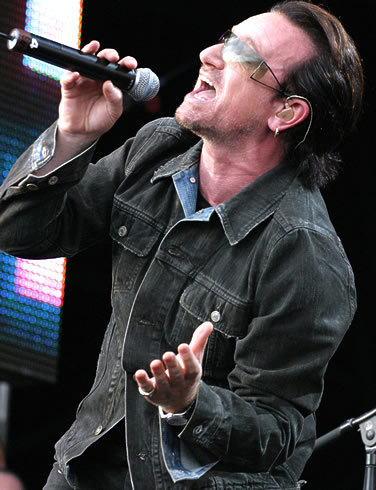
Birthday Biography: Bono


I first heard U2 when I was in high school, and while one of my friends was a huge fan, they just didn't do much for me. Maybe I just wasn't ready for them. I was still quite influenced by the bands that my older brothers listened to, which was mostly groups like Eric Clapton, the Beatles, Yes, and Styx (yes, I know). It wasn't until college that I became more exposed to alternative music. Surprisingly, it took leaving suburban Pittsburgh and moving to little Clarion, PA to find out what great music there was in the world. Between my new friends and the college radio station, I started finding out about bands like The Cure, Psychedelic Furs, Squeeze, Crowded House, and so many more. By the late 80s, a little radio station called WXXP appeared in Pittsburgh. Finally, there was decent radio in Pittsburgh! This is when I "discovered" U2. After that, there was no stopping me.

 The real moment when my thoughts on U2 began to change was when I saw them perform at Live Aid in 1985. Although I desperately wanted to be in London to see the concert, I was home watching from my living room. But what a performance from U2! This moment was magical!


So, in honor of lead singer Bono's 52nd birthday on May 10, I'm going to review my favorite U2 albums.


War (1983)

War was the first U2 album I owned. After their powerful performance at Live Aid, I started exploring their albums. By then, the band had released 5 albums (Boy, October, War, Under A Blood Red Sky, and The Unforgettable Fire) and one EP (Wide Awake In America). I was aware of the hits, but once I got my hands on this album, I was no longer a casual fan. The world was a crazy place in the early 80s. The Cold War was in full swing and the threat of nuclear war was always just hovering above us all. These topics, along with The Troubles of Northern Ireland, were explored on War. Even though I lived a good, middle class life in America, I yearned for a connection to places outside of my immediate world. This album delivered. Their commitment to social issues and their Christian faith, that was interwoven into their songs, had a strong impact on me.  

Favorite tracks: Sunday Bloody Sunday, Seconds, "40"


Achtung Baby (1991)

This album came after a period when the band came very close to breaking up. After the huge and crazy success of The Joshua Tree (1987) and the release of the film and album Rattle and Hum (1988), Bono made a comment during a concert in late 1989 that the band had to go away and "dream it all up again," which had fans and the media in a frenzy. As we know, they didn't break up, but they needed to work out some issues they were facing as a band. After a long-deserved break, the band headed to Hansa Tonstudios in Berlin to work out their problems. The result is, in my opinion, their best album. It isn't as overtly social or political as their earlier albums, but that didn't stop a song like One from becoming an anthem of sorts for the fight against HIV/AIDS. The band donated a large portion of the proceeds from One to different AIDS charities. This song has proved to be one of U2's most famous songs, which touches so many people in so many different ways. At its heart, it talks about the need for the world to get along, whether we all like each other or not. In the early 2000s, Bono created a group to help fight AIDS, debt, and poverty in Africa, which eventually merged into One in 2008. You can read more about this organization here. 

Favorite tracks: One, So Cruel, Even Better Than The Real Thing, Until The End Of The World


Zooropa (1993)

This album was meant to be an EP, to be released before the band began the European leg of their Zoo TV tour for Achtung Baby. Initially, I wasn't sure how much I liked this album. It actually took several years before I really began to appreciate it. It's somewhat a continuation of Achtung Baby, but it delves a bit more into the electronic and house music that had been influencing them as song writers. The big hit from this album was Numb, which gave the lead to The Edge, instead of Bono. Personally, I felt this was a waste of the lovely singing voice of The Edge, which we usually only hear in combination with Bono. My favorite on this, and quite possibly any U2 album, is Stay (Faraway, So Close). It's a beautiful and haunting love song that was written for the Wim Wenders film Faraway, So Close and inspired by the style of Frank Sinatra. They don't perform it very often, but I was lucky enough to see them sing this song last summer on their 360 Tour when it came to Pittsburgh. That was a highlight of the show for me and my friend Michele!

While this album isn't as focused as most of the other work, it does have some very special moments, which is why this is one of my favorite albums. 

Favorite tracks: Stay (Faraway, So Close), Zooropa, Lemon, The Wanderer.


This album marked another transition for the band. It's a return to more of a pop/rock album than the electronica and dance music they were exploring in the 90s. This album also put them back up on top as the biggest and most well-known band in the world. All is also a return to songs with more personal and social aspects to them. On the personal side is Stuck In A Moment You Can't Get Out Of. Bono wrote this in response to the suicide of his good friend Michael Hutchence, lead singer of INXS. As for the social commentary, the song Walk On was written about political activist Aung San Suu Kyi. All also has elements of pure rock 'n' roll fun in Elevation. Every time I have seen U2 perform this song live, it makes the whole arena or stadium vibrate with people bouncing in time to the music. Pure joy!

Favorite tracks: Beautiful Day, Elevation, Walk On, Stuck In A Moment That You Can't Get Out Of

I'm going to end this with another performance video. Just try and keep yourself from bouncing in your seat!


 -- Post by Tracy


Tuesday, December 27, 2011

Staff Recommendation #4: The Works of Vivian Vande Velde

Today we've got a very special book review, written by teen volunteer Amanda. Enjoy her funny, insightful look into two YA fantasy reads!

* * * * *


The Changeling Prince by Vivian Vande Velde


Let me start this off by making one point clear: I hate the Twilight series. (Irrelevant as you might think it is, that’s important.) That being said, I did not expect much from The Changeling Prince. Ever since I had the displeasure of reading the new “Stephenie Meyer” rendition of werewolves, picking up a book with werewolves in it has brought me both mental and physical pain (the physical pain being caused by me violently throwing the book against my foot whenever I read a new passage about how attractively attractive the werewolf looked). So once I’d finished reading The Changeling Prince and my feet were still in perfect condition, I knew it had been a success.

Here’s the story: For his entire life, Weiland (the main character, in case it wasn’t completely obvious from me mentioning his name first) has been under the control of the evil sorceress Daria. She kidnapped him when he was still just a wolf pup, and changed him into a human. Now, he isn’t the only animal-turned-human that Daria owns. She has a wide variety of bears, wolves, birds, etc. (like a Beanie Baby obsession gone bad). Whenever Daria wants them to do something for her, she’ll change them back to their original animal form and send them out. Naturally, being a main character and all, Weiland is not satisfied with this lifestyle. He doesn’t want to kill people, he doesn’t like waking up and tasting blood in his mouth: the usual. But how can he manage to escape when Daria has complete control over him? And that’s when the adventure begins.

Now I can tell you that Weiland is one of my favorite characters I’ve read about. Ever. And that’s because he isn’t all moral. Sure, he doesn’t like to kill people, but he’ll beat you pretty hard if you deserve it (and maybe sometimes even if you don’t). That’s a characteristic you often see in side characters -- while the main character is being moral and brave, trying to hold the side-character back. To see this from the main character was really refreshing. In any case, I don’t want to spoil any more (actually, my fingers are starting to hurt from this annoying computer keyboard, but same difference), so the main point I am trying to get across is: read the book.


The Conjurer Princess by Vivian Vande Velde


Now, after finishing The Changeling Prince, to my extreme joy I discovered that there was a sequel. Oh, how I wish I hadn’t. Apparently, Vande Velde wrote this book ten years before she wrote The Changeling Prince, and it shows. Honestly, I liked it so little that I can’t even remember most of the plot … or the main character’s name. (I just Googled it: It’s Lylene.) Alright, so Lylene is supposed to be this good, caring, brave, perfect (I know … already you can’t stand her) heroine. Instead, the author accidentally made her bratty, annoying, awful, flirty, and just plain unbearable. The only reason I could even finish this book at all was the fact that Weiland was in it (and honestly, he wasn’t nearly as awesome as he had been in The Changeling Prince). So, the main point I’m trying to get across with The Conjurer Princess is: don’t read this book. Don’t. You will regret it. I promise.

So, if you’re an author, and you’re reading this, it is a warning. If you ever decide to write a prequel to a book you wrote ten years ago, don’t. No matter who you are, or how good you think you were at writing ten years ago, your style will have changed within the last decade (hopefully on the improving side -- but really, it goes both ways). If you’re not careful, you could end up with this disaster happening to you, and the next time someone writes a review like this, it will be about your book series. Be warned.


Request The Changeling Prince by Vivian Vande Velde

And, if you care to risk ignoring Amanda's sage advice, borrow an interlibrary loan copy of The Conjurer Princess


-- Our thanks to teen volunteer Amanda for her fantastic reviews!

Friday, October 7, 2011

Beyond the Horror


Last week I discussed my all-time favorite author: Stephen King. I mentioned how odd it was, in some respects, for me to be a fan of his -- primarily because I am absolutely not a horror fan. And yet there's something about Stephen King's writing style and thematic story elements that draw me to his writing regardless of that.

But another reason I can enjoy him so much is that he's not, strictly speaking, a "horror writer." Oh, he definitely writes horror -- make no mistake about that -- but many of his books can be classified as thrillers, or mysteries, or science fiction. And even his straight-up horror offerings have more to them just the scares (not that he doesn't write some pretty great scares).

So if you, like me, are not generally a fan of the horror genre, but find yourself wanting to give King a try, here are some alternate-genre reads of his that might be more up your alley.


Duma Key

Edgar Freemantle, owner of a construction company, hasn't sketched a picture in years -- until a construction site accident leaves him with an amputated right arm, memory and speech problems, and a flush of anger issues. Renting a beach home on the west coast of Florida to recover, Edgar takes up his old art hobby once again, only to discover two things: his paintings are better than they've ever been before, and the things he's painting are starting to come true. While many critics commented on the obvious parallels between Edgar's experiences and Stephen King's own near-death experience from several years previous, what I was more impressed by with this novel was the characters. The main characters are interesting and well-developed, and you come to genuinely care about them by the end of the novel.


"Rita Hayworth and Shawshank Redemption" // "The Body"

"Different Seasons" collects four short novels by Stephen King, and two of those -- "Rita Hayworth and Shawshank Redemption" and "The Body" -- are among his finest non-horror works ever.

"Rita Heyworth" -- considered to be one of King's all-time masterpieces -- tells the story of two prison inmates: Red, a "lifer" who has just been denied parole; and Andy, one of the more unusual inmates to serve time at Shawshank. What follows is a story that is equal parts hope and redemption; to give away any more of the plot would be a disservice to the story.

//

"I never had any friends later on like the ones I had when I was twelve. ... does anyone?"
"The Body" details the summer adventure of four pre-teen boys in 1960s Maine. While the object of their quest -- another boy who went missing and is now presumed dead -- is macabre, the story itself is not. It is, as the saying goes, about the journey, not the destination, and it's more about the stories of these four boys than it is anything else. King captures the voices of four youthful characters with his usual precision -- the kids are buoyant, silly, crude, and above all optimistic, giving a portrayal of childhood that is far from idealistic but still, in its way, fondly remembered.


(Both of these novellas happen to have been made into truly excellent film adaptations: The Shawshank Redemption starring Tim Robbins and Morgan Freeman, and Stand By Me, starring Wil Wheaton, River Phoenix, and Richard Dreyfuss.)


The Eyes of the Dragon

As I mentioned last week, this was my first Stephen King novel, given to me by my mother when I was in high school. George R.R. Martin meets Grimm fairy tale, it's a high fantasy adventure about two royal brothers -- one of whom is Crown Prince, while the other becomes a witness to a murder of their father and King. Simply and straightforwardly told, it's something most fantasy fans should enjoy -- while also being a pleasant change of pace from the usual Tolkien derivative fare.


The Dead Zone

This one's a science fiction read that doubles as a thriller: if you could see the future, how far would you go to prevent it? Johnny Smith is injured in a car accident and put in a five-year coma; when he awakens, he finds himself with five years of his life gone, his parents stressed to the breaking point, and his former girlfriend now married to someone else. That in itself could have made for an interesting story, but King takes it a step further: the accident has left Johnny with psychic abilities. By touching an object, he has visions about the person that the item belongs to -- including visions of the future. And one vision in particular is cause for alarm, detailing the cataclysmic fate that awaits the world if presidential hopeful Greg Stiltson is elected to office. As sci-fi thrillers go, you can't ask for much better than this. (And yes, this book resulted in both a motion picture adaptation, as well as a six season TV series.)


The Green Mile

King is well-known to his fans for being unafraid to try different formats for his work: Riding the Bullet was originally released exclusively online, Ur is only available to read on the Kindle, and his new short stories are still routinely released in magazines. With "The Green Mile," King tried his hand at the serial novel -- the book being released in six parts that were issued monthly in low-priced paperback format. (The book has since been collected into one large novel.)

Another prison novel, this one differs from "Shawshank Redemption" in its supernatural twist. Told from the perspective of Paul Edgecombe, the block supervisor of the Cold Mountain Penitentiary death row, it details the story of inmate John Coffey, a man on death row for a crime he may or may not have committed. Another story about redemption and innocence, with a decidedly different twist from "Shawshank," this story comes to focus on Coffey and the question of his innocence or guilt -- not to mention his mysterious healing powers. This book, too, has been made into a well-known film, starring Tom Hanks and Michael Clarke Duncan.


The Girl Who Loved Tom Gordon

Nine-year-old Trisha McFarland is hiking with her mother and brother when she falls off the trail for a few minutes to get away from her family's bickering. A nightmare follows when a wrong turn finds her lost in the woods with nothing but a backpack of snacks, a Walkman, and her Tom Gordon baseball cap. The plot is simplistic in set-up, but the story it tells -- about courage, determination, family, and the power of faith (in both God and baseball) -- is anything but. I read this book for the first time over a decade ago, and it still remains my favorite King read.


The Dark Tower series

"Go, then -- there are other worlds than these." Stephen King's masterpiece is also his hardest work to describe. Science fiction? High fantasy? Epic? "Epic," at least, is certainly a word to describe this seven-book series that was nearly 20 years in the making, and which also serves to tie together many of the characters, settings, and stories of the rest of King's novels. And yet, it's not a horror series, reading more like a Spaghetti Western tribute crossed with post-apocalyptic fantasy ... and that's just the first book. Whether you like fantasy, science fiction, Westerns, or Epics, there's probably something in this book for you. (There's even a Harry Potter reference for the particularly sharp-eyed!)


-- Post by Ms. B

Friday, June 17, 2011

Staff Recommendation #3: "The Faerie Path" by Frewin Jones

"The Faerie Path" by Frewin Jones


Staff review by C.O.

At first, I thought this was going to be your typical faerie princess story -- where princess meets prince, princess loses prince, and then in the end the princess gets her prince and lives happily ever after. But I was pleasantly surprised to find that this wasn’t the case.

Anita Palmer was living the typical British teenage life, with school, friends, a boyfriend, and parents. But what she didn’t know was that she was in fact the Princess Tania, the lost princess of Faerie and the youngest daughter of King Oberon and Titania. On her 16th birthday, she finds herself in a boating accident with her boyfriend Evan, landing her in the hospital with no recollection of what happened. Evan has disappeared and a mysterious book is mailed to her. When she opens the book, she finds that the pages look empty ... but are they really? Believing that she is suffering ill effects from the boating accident, she hears a mysterious voice calling to her. What comes next is both exciting and frightening for young Anita -- when she finds herself in the land of Faerie.

While in Faerie, Anita meets Gabriel Drake, a man with power and evil on his mind. (He's also the man who brings through the fold into Faerie.) As Tania, she'd been engaged to Gabriel but had vanished on the eve of her wedding. She also meets up with the missing Evan, who's also in the land of Faerie -- and who has been working for Gabriel. She feels betrayed and hurt because she really believed the love shared between her and Evan was real. She doesn’t know what to think now.

Anita also finds out that she is one of seven daughters of the royal house. Each sister has different magical powers and Anita/Tania finds out that her magical power is the ability to travel between the two worlds. She meets her father, King Oberon, but finds out that her mother the Queen is dead. But is she? Something is fishy and Anita/Tania must find out what really happened.

The land of Faerie is nothing she could ever imagine, but she is torn between the love of her mortal family living in England and the duty she feels towards her Faerie family and the kingdom of Faerie. She has to make a choice, but what that choice will be has everyone guessing. The land of Faerie, the people she meets, the sisters she comes to love -- they all play a part in her decision. One thing she does know is the love she feels for her sisters: Eden, Sancha, Zara, Cordelia, Hopie and Rathina. One of them is harboring a dark secret which could tear the land of Faerie apart.

One of my favorite characters was Cordelia, because she shared a special bond with the animals, and they in turn were very loyal to her. When called upon, the animals were a great help in Anita/Tania’s quest.

I enjoyed the story of Anita/Tania and all that happens to her. Does she discover what happened to her mother, Queen Tantia? Does she fulfill her fate? Does she stay in Faerie or go home to her mortal parents? Come join me in finding out what happens to Anita/Tania as she follows her destiny.

Request "The Faerie Path" by Frewin Jones

Monday, May 9, 2011

Staff Recommendation #2: "After the Golden Age" by Carrie Vaughn

"After the Golden Age" by Carrie Vaughn


Staff Review by Ms. B

I love superheroes. I've been a devout fan of Batman and Superman since childhood, I get excited for each and every big blockbuster superhero flick to come to the summertime movie screens, and I have a ever-expanding pull list of comic books on reserve for me at the local comic book shop. Lois Lane was my childhood heroine -- and the Joker is my all-time favorite villain, not just from comic books but from fiction in general.

So I really enjoy comic books, but it's also true that I enjoy superhero tales in just about any format. And, as I love reading novels, I'm always on the look-out for books that use the novel format to tell stories about these super-characters which are more often reserved for the comic book format. Carrie Vaughn's new, comic-book-inspired novel "After the Golden Age" is a surprisingly wonderful book that fits the bill exactly. Although, don't get me wrong -- it's not just for fans of comic book superheroes like myself, but for anyone looking for a well-written, character-rich coming-of-age story.

The book stars Celia West, only child of Suzanne and Warren West -- or, as her parents are better known, Captain Olympus and Spark, the leaders of the Olympiad (the story's Fantastic-Four-esque band of superheroes). Celia, however, has inherited no superpowers of her own, meaning that the child of Commerce City's greatest superhero duo is herself ... an accountant.

She's also a frequent kidnapping victim (the city's supervillains like to use Celia as leverage against her parents), a disappointment to her father (who, in addition to being super-strong, has anger management issues), and she's hiding a horrible mistake in her past that she's still trying to put behind her (this of course does not work). But as Celia is hired by the D.A.'s office in order to prepare a case against the Destructor (the city's most notorious criminal mastermind), it's not really to the city or her parents that Celia needs to prove herself.

I was pleasantly surprised by this book's humor and world-building detail, as well as by the intricate mystery plot that unfolds during Celia's determined digging for details into the court case she's working. But I was stunned by the depth of character development that Celia undergoes, as she struggles to forgive herself for her past, and decide who she is and what it is that's truly important to her. Most twentysomethings -- or anybody who has ever been twentysomething -- could relate to a character like Celia West, who has a lot of self-doubt and anger but is still filled with determination to find herself and fight for what she believes in.

For comic book fans, there's no denying that this book -- with its in-jokes and references (I have no doubt that Vaughn's Hawk is a nod to Batman) -- is a special treat. But for anyone looking for a quirky mystery story with a strong, relatable, developing central character, you can't do much better than "After the Golden Age."


Request "After the Golden Age" by Carrie Vaughn

Thursday, March 24, 2011

Patrons Who Read This Also Liked ...


One of the most challenging and most enjoyable part of being a librarian -- at least for me -- is Reader's Advisory.

Most of you are probably aware of Amazon.com's "Customers Who Bought This Item Also Bought" feature. Find an item on Amazon, and halfway down the page you'll see a list of further suggestions for you based on what you're already viewing. Look up a Harry Potter book, for instance, and Amazon will suggest the rest of the series to you -- along with books from the Twilight, Lord of the Rings, and Charlie Bone series. The idea is that, if you're looking up Harry Potter books, you're probably a fantasy fan to boot -- and Amazon will suggest similar products to you in the hopes that, y'know, you'll buy a few more things in addition to what you'd actually come to the website for. What you may not know is that we here at the library have our own methods of "suggesting similar items" to our patrons.

Many Monroeville Public Library patrons do know that they can ask us librarians and library staff members for book recommendations. And if you've never tried it before, keep in mind that at the library, you've got the added bonuses of:

A.) a real live person thinking about what you might like to read next, and

B.) no need to purchase your selection. We won't try to talk you into buying something here, after all -- we're happy just to have you leave with a (free) book in your hands that you're excited to try. And so, to that end: Reader's Advisory.

Reader's Advisory is part reference, part service here at MPL. We've got an actual Reader's Advisory guidebook section (located near the Front Desk), where you can find guides to reading suggestions like Read On Historical Fiction: Reading Lists for Every Taste, The Real Story: A Guide to Non-Fiction Reading Interests, Blood, Bedlam, Bullets, and Badguys: A Reader's Guide to Adventure/Suspect Fiction, and many more guides to suggestions of what you might like to read next in your favorite genres.

But we've also got a building full of librarians and library staff who are eager to help you find your next great read. There are all sorts of recommendations we can make to you, too. Ask us about the last great book we read. Or, if you find a staff member whose reading tastes are a bit different from yours, tell us about your favorite titles and authors and we'll think up some "read-alikes" for you -- read-alikes being, of course, books that are similar to each other (like our Harry Potter example up above).

Suggesting books that people might like to read can be challenging -- and also a lot of fun. As the teen librarian, I find that sometimes it's quite simple to come up with a title my teen patrons might like. ("Do you have any books about vampires?" is pretty easy to answer!) But sometimes, I've got my work cut out for me -- particularly if someone is looking for a good western or romance, two genres I myself don't read particularly often.

Of course, that's part of the fun and the challenge, to come up with a good book suggestion that might be outside our individual realm of expertise. At that point, we'll probably turn to outside help -- pulling up database listings of read-alikes for your perusal, or flagging down a fellow staff member who we know happens to share an interest in the genre you're looking for. (My co-workers know that I'm the Go-To Gal when it comes to science fiction recommendations, for instance -- and, hey, if anybody out there is looking for a great graphic novel suggestion, I'd be more than happy to help!)

So if you're looking for something just like the book you finished ... or for the latest great thriller ... or for something different entirely ... stop by our library and check out everything our Reader's Advisory services have to offer. We'd love to help you find your next great read!

Thursday, March 17, 2011

Staff Recommendation #1: "Life" by Keith Richards


"Life" by Keith Richards, with James Fox


Staff Review by B. Kendig

Keith Richards's new autobiography does not disappoint. This 564-page tome, with 32 pages of photographs, is witty, self-deprecating, and, at times, poignant. There is, for instance, the phone call he receives when he's about to go on-stage, with the news that his 3-month-old son, Tara, had just died. Through such memories, we fans get a glimpse into the real Keith, who has always been my favorite Rolling Stone.

He writes a lot about his family and early years. One vignette depicts how he and his aunt would sing "When Will I Be Loved?" together (which also happens to be my favorite Everly Brothers song). Goodness, he and I would have so very much to talk about if ever we sat down for a chat! The book also tells of his first great romance with Ronnie Spector in Detroit, his mercurial relationships with group founder Brian Jones and Mick Jagger, and, of course, Anita Pallenberg, already a movie star in her own right when she met the band -- and his American wife Patti Hansen.

He is unapologetically still the quintessential "bad boy." For any scholar of the Sixties, "Life" is a must-read.

Request "Life" by Keith Richards, with James Fox

Request the Large Print version of "Life"

Request the Audiobook of "Life"