Tuesday, February 7, 2012

Birthday Biography: Charles Dickens


Confession time: this English major has never read any Charles Dickens.

I know -- shameful, right? We covered Trollope and Hardy in my 19th-century British Literature class, but somehow we never got around to Dickens.

But of course, the thing about Dickens is that his influence on literature was so great that you don't have to have read his stories to know something about them.

Charles Dickens was born two hundred years ago today, to parents Elizabeth and John Dickens. John was a clerk in the Naval Pay Office and, unfortunately, was somewhat terrible with matters of money. He eventually wound up imprisoned for debt. Incredibly, Elizabeth and the rest of their eight children would soon join John in Marshalsea Prison -- with the exception of Charles himself, who was put to work instead in Warren's Blacking Factory. His father was eventually released and was able to rescue 12-year-old Charles from the factory life, but the experience had already left its mark. Charles spent the next three years as a day pupil at a London school before getting another job at age 15 -- this time as an office boy at an attorney's. By age 17 he was a freelance reporter at Doctor's Commons Courts. He'd studied shorthand during his nights at the attorney's, and by 1832 he was a highly successful shorthand reporter for debates of Parliament in the House of Commons. Dickens's first published stories would begin to appear in 1833, although he'd continue on in his career as a reporter until the runaway success of the serialized novel The Pickwick Papers allowed him to become a full-time novelist. (He'd also publish short pieces under the unusual pen name of "Boz.")

Dickens would marry Catherine Hogarth in 1836 (they'd eventually have ten children), and followed up The Pickwick Papers with Oliver Twist and Nicholas Nickleby. The following two decdes would see the serialized publication of such other novels as David Copperfield, A Tale of Two Cities, and Great Expectations. He'd also tour through Canada and America in 1852 (and create a bit of buzz upon publishing his American Notes, commenting a bit unfavorably on certain American habits such as tobacco chewing).

The work that is perhaps his most famous was first published in December 1844. The short novel A Christmas Carol was the first of several Christmas-themed books that Dickens would produce, but Christmas Carol would, by far, remain his most popular. The story stars Ebenezer Scrooge, a miserly man visited by three Christmas ghosts (of Past, Present, and Future) intent on convincing Scrooge to change his ways. The simple but memorable tale was an instant hit that's been credited with bringing a sense of "Christmas cheer" back to England and America during the era. The novella has never been out of print since its original publication and remains a perennial Christmas classic. It's been brought to life in countless adaptations and variations on the stage and the screen, with the role of Scrooge being played by everyone from Reginald Owen and Basil Rathbone, to Albert Finney and Bill Murray, to Patrick Stewart and Michael Caine -- and, most recently, Jim Carrey, Kelsey Grammer, and even Batman himself.


Of course, Dickens is an author so classic that you don't have to have read any of his works to have felt his influence on literature. From such famous lines as "It was the best of times, it was the worst of times" and "Please sir, I want some more" to such characters as Scrooge, Marley, Pip, Miss Havisham, and Oliver Twist, Dickens's work has become an indelible part of popular culture. (The character of Pip has even made an appearance on the animated show South Park.)

So if, like me, you'd like to know more about Dickens -- but aren't quite ready to dive into Bleak House just yet (I've been trying to read that one for awhile) -- check out the links below for more about this literary giant.

(And, while we're making confessions: I've never read any Jane Austen either. Then again, she was born in December, so I've got some time yet!)


- Charles Dickens - the LA Times

- Dickens: A Brief Biography - VictorianWeb.org

- Five Myths About Charles Dickens - the Washington Post

- Charles Dickens Still Resonates - Christian Science Monitor

- World Celebrates 200th Anniversary of Dickens's Birth - BBC News


-- Post by Ms. B

Friday, February 3, 2012

So Our Children Can Soar


Rosa Parks's courageous action that December evening wasn't the first of its kind.

The story is a famous one. On December 1, 1955, Parks was riding a bus in Montgomery, Alabama, on her way home from her job as a seamstress. As the bus began to fill, Parks and three other African American passengers were ordered by bus driver James F. Blake to surrender their seats to white passengers. The other three African American passengers eventually got up. Making an instantaneous decision that she will no longer tolerate the discrimination, Rosa Parks remained seated. (Later, Parks would explain that this was not her first encounter with Blake -- he once made her get off the bus and re-enter through the rear door instead.)

Parks was arrested that day for her refusal to vacate her seat for a white man (a crime at the time under the "Jim Crow" segregation laws). But as the story of her courage spread, others were inspired to follow her example. A group of civil rights activities called the Montgomery Improvement Association organized the Montgomery Bus Boycott. (The leader of the boycott? A young Baptist minister, new to the area, by the name of Martin Luther King, Jr.) Passengers stayed off the buses in droves, choosing to walk, carpool, or bike-ride instead -- and with African Americans comprising nearly 75 percent of the riders in the Montgomery area, the bus company feels the effects. The number of buses in the city was cut, while fare prices were raised. And after 381 days, the boycott was ended -- when the Supreme Court ruled Montgomery's segregation laws to be unconstitutional.


Although best remembered for this act of courage, this was by no means Parks's only contribution to the civil rights movement -- or even her first. Rosa and her husband, Raymond Parks, were active members of their local NAACP chapter for many years before the incident in Montgomery. Later in life, Parks would go on to co-found the Rosa and Raymond Parks Institute for Self Development (an organization which aims to target the youth who might be overlooked by other program opportunities, motivating and directing them to reach their full potential). She'd receive the Presidential Medal of Freedom in 1996 from President Bill Clinton for her lifetime of work, and was awarded a Congressional Gold Medal in 1999.

Parks's 99th birthday would have been this February 4th (she passed away in 2005). But her myriad accomplishments -- best remembered in that iconic act of courage in 1955 -- ensures that her legacy lives on. She was and always will be rightly recognized as the "mother of the modern day civil rights movement."


For more on Rosa Parks:

- Rosa Parks Biography - Academy of Achievement

- Biography of Rosa Louise Parks - from the Rosa and Raymond Parks Institute for Self Development

- Rosa Parks Bus - The Story Behind the Bus

- Rosa Parks Refuses to Give Up Her Seat - How Rosa Parks Fought for Civil Rights (from Scholastic for younger readers)


From our Library's Collection:

- Stride Toward Freedom: The Montgomery Story - by Dr. Martin Luther King, Jr.

- Rosa Parks: a Life - by Douglas Brinkley.

- Our Children Can Soar: A Celebration of Rosa, Barack, and the Pioneers of Change - by Michelle Cook.


-- Post by Ms. B

Tuesday, January 31, 2012

Tesseracts


"You have to write the book that wants to be written. And if the book will be too difficult for grown-ups, then you write it for children." -- Madeleine L'Engle


It's been fifty years since Madeleine L'Engle's science fantasy novel, A Wrinkle in Time, was first published. Rejected at least 26 times by publishers before finally being accepted for publication in 1962, it's been continuously in print ever since. Marketed as a young adult novel (probably on account of its teenage protagonist), it's gone on to become a beloved classic for readers of all ages.

Describing the premise of this weird, wild, wonderful book can be tough, because there's no way to do such a unique story justice in a simplified summary. Suffice it to say, the book centers around Meg Murray, an awkward (and somewhat angry and stubborn) high school student. Living in a tiny rural town, she's lost at school but takes comfort in the understanding of her family: her biologist mother, her ten-year-old twin brothers -- and most especially her five-year-old brother, Charles Wallace, who is (to put it mildly) something of a child prodigy.

Her physicist father, however, is missing -- last seen leaving home on special assignment for the government. It's in Meg and Charles Wallace's attempt to find him (with the help of classmate Calvin O'Keefe, and three highly unusual neighbors) that the book finds its story, but to say more would be to give too much away. It quickly becomes apparent, however, that Meg's missing father is far enough away that finding him will involve a bit of traveling. Or, if you will, tessering.


What follows is a story about wormholes and missing laundry, alien planets and physics homework, time travel and midnight sandwich snacks. It's a delightfully bizarre and flawless melding of the ordinary and the extraordinary, of the daily routine and the outrageously unusual, that plays a large part in making this such a unique story (even by the standards of sci-fi!).

The book also has more unique messages than what might is often found in the standard sci-fi fare: the importance of family and relationships, that stubbornness and anger can occasionally be great gifts (if you can only use them correctly) -- and that we don't have to all be exactly alike to be equal to each other.

There's also some light -- but undeniable -- religious allegory in its pages, as issues of faith and belief are explored (albeit of an unorthodox-enough nature that L'Engle joins the ranks of such authors as J.K. Rowling and Judy Blume for having her books occasionally challenged and banned). Science and faith co-exist quite easily in the pages of L'Engle's Time Quartet (which is not to say that you need to be a religious sort to enjoy her writing).

But even more unusual at the time than her gentle blending of science and faith was L'Engle's decision to make the main protagonist of her science fiction tale ... female. Even before Anne McCaffrey and her sci-fi heroines, L'Engle had broken new ground by featuring a young girl as her main character. For this reason (among others), her publishers were unsure if the book would sell -- so it was a surprise to everyone when the book not only became a hit but won the Newbery Award in 1963.

To the book's millions of fans, however, it's not surprising at all. If you've never read this unique story, you might consider giving it a try in celebration of its fiftieth anniversary. From Camazotz to tesseracts, L'Engle's classic has something unique for every sci-fi fan.


Pressed for time? Check out a fairly complete telling of "A Wrinkle in Time" -- in ninety seconds!


"A Wrinkle In Time" In 90 Seconds from James Kennedy on Vimeo.


-- Post by Ms. B

Thursday, January 26, 2012

Australia Day


A few years ago, I was lucky enough to accompany my husband on a business trip to Australia. It's a country I've wanted to go to since I saw the film "The Man From Snowy River" in the mid-80s. Of course, the movie is set in the 19th century and doesn't reflect what the country is like today, but for some reason it sparked an interest in me. So when I had the chance to finally see this country that I had been dreaming about for years, I couldn't pass up the opportunity. And I was not disappointed!

Australia, as we now know it, was created as a British colony in the late 18th century as a penal colony. The first fleet of ships arrived in what is now Sydney harbor on January 26, 1788. Even in the early days of the colony, this date was celebrated. By the mid-19th century, transportation of convicts to Australia was beginning to wane, but January 26th was still marked by dinners and other celebrations in the state of New South Wales. However, it wasn't until 1994 that Australia Day was officially celebrated throughout the entire country on January 26th.

In keeping with the nation striving to improve its relationship with the indigenous people of Australia, the nation has attempted to include the history and culture of the Aborigines. Since Australia Day celebrates the arrival of the British, it has not always been a day of joy for the Aboriginal people. Over the years they have either been forced into participating or boycotting the celebration, although most of the country didn't even notice. Now, all of Australia is celebrated. And it is celebrated in ways that most Americans would find familiar - fireworks, concerts, and parades.

Australia Day 2012 update:
Unfortunately, there was some controversy surrounding this year's festival, which has already taken place due to the time difference (Australia is 16 hours ahead of Monroeville).  A large group of Aborigines surrounded a restaurant in Canberra, where Prime Minister Julia Gillard was meeting with the Opposition leader and trapped them inside. Riot police had to be brought in to escort them out. Click here for more information on the incident.


Below are some links to websites about Australia and Australia Day.

Australian Government website:  http://australia.gov.au/about-australia

Australia Day Information : http://www.australiaday.org.au/

Additional Australia Day Information: http://www.australiaday.com.au/


Books about Australia (history and travel):

The Fatal Shore by Robert Hughes

In A Sunburned Country by Bill Bryson

A Brief History of Australia by Barbara West

A Traveller's History of Australia by John H. Chambers

The Original Australians: Story of the Aboriginal People by Josephine Flood

A Concise History of Australia by Stuart Macintyre

Keep Australia On Your Left: A True Story Of An Attempt To Circumnavigate Australia By Kayak by Eric Stiller


Travel Guides:

Australia (Insight Guides)

Australia (Berlitz)

Frommer's Australia

Australia (Eyewitness Travel Guides)


Documentaries (DVDs):

Dreamtime of the Aborigines

Australia Revealed

Modern Indigenous Culture
Feature Films:

Australia (2008)

Danny Deckchair (2003)

Ned Kelly (2003)

Adventures of Priscilla, Queen of the Desert (1994)

Muriel's Wedding (1994)

Strictly Ballroom (1993)

Crocodile Dundee (1986)

Mad Max (1979)


-- Post by Tracy

Tuesday, January 24, 2012

Nevermore


On January 29, 1845, a poem was published in the pages of The Evening Mirror, a daily New York newspaper. The poem was an instant success, catapulting its author to fame and helping to cement his place as one of the classic American writers. 167 years after its original publication, "The Raven" remains not only Edgar Allan Poe's best-known work, but also one of the most famous poems in American literature.

"The Raven" -- along with such Stephen-King-esque fare as "The Fall of the House of Usher," "The Cask of Amontillado," and "The Tell-Tale Heart" -- has cemented Poe in the public consciousness as a somber, depressed, gothic figure, who may or may not have been a little crazy.

But scary stories aside (and they are true masterpieces of psychological horror, don't get me wrong), our modern-day popular perception of Poe is mostly incorrect. An innovator in the genre of science fiction, the inventor of modern-day mystery and detective novels, and a fierce literary critic in his time, Poe gets his morose, gothic reputation primarily at the hands of Rufus Griswold, the man (and literary rival) who wrote Poe's obituary.

In some ways, much of Poe's life is as mysterious as the cryptic puzzles he liked to invent for his mystery tales. The basic facts are clear: he was born in 1809 to parents who were traveling actors, although by the age of three both of his parents had died. He was raised instead by wealthy tobacco merchant John Allan, and his wife Frances Valentine Allan (from whom Poe received his "middle" name). Poe had early designs on becoming a writer and had composed enough poetry by the age of 13 to fill up a publishable manuscript, although it would be another five years before his work would first appear in print.

He attended school at both the University of Virginia and the United States Military Academy at West Point, the latter coming after Poe spent two years enlisted in the United States Army. After the death of Frances Valentine, the woman who'd raised him, Poe fell out completely with John Allan (a man he'd never gotten along with). Plagued by poverty as he struggled to make a living with his writing, he turned to his aunt, Maria Clemm. He would eventually move to Richmond and later bring Maria down to live with him -- along with Maria's daughter, Virginia, who Poe would eventually marry.

Poe's writing began to grow in popularity, but it wasn't until the publication of "The Raven" that his royalties began to grow as well. By now Poe was beginning to attract large crowds to his lectures, as well as gaining attention for being a fierce literary critic. But in 1847, Poe's wife Virginia finally succumbed to the tuberculosis which had plagued her for several years -- tuberculosis also being the cause of death for Poe's mother, brother, and foster mother.

Poe himself would die two years later, and modern-day historians still debate both his living habits of the past few years (was he really an alcoholic?) as well as his still-unknown cause of death. A few days after he died, literary rival Rufus Griswold would pen his scathing -- and patently untrue -- obituary for Poe, painting the author as a raving, drunken womanizer "with no morals or friends." Unfortunately, that (highly) inaccurate picture of Poe is still the one most people hold today.


The truth of the matter is that Poe is a much more complicated figure than that. For my part, I didn't become interested in Poe until I read his short story "The Purloined Letter" in high school and discovered, much to my surprise, that Poe essentially invented the mystery genre. His "consulting detective" character, C. Auguste Dupin, appeared in 1841 in the short story "The Murders in the Rue Morgue." "Murders" is widely held to be the first modern-day detective story, featuring as it does the first-ever fictional detective. (Hence the Mystery Writers of America choosing to name their annual awards "the Edgar" to honor the year's best works of mystery fiction, non-fiction and television.) A far more famous fictional detective owes his existence in large part to Dupin's inspiration -- prompting Sir Arthur Conan Doyle to offer a wry tip of the hat to Poe in one of his stories. When Dr. John Watson makes a mention of Poe's famous detective, Sherlock Holmes responds that, in his own opinion, "Dupin was a very inferior fellow." (Conan Doyle did not share his character's humorous derision, however, and was known to be an admirer of Poe's work.)

Likewise, Poe's short story "The Unparalleled Adventure of One Hans Pfaall" was considered a ground-breaking work of science fiction, telling a tale about space travel and otherworldly aliens -- even if it was meant, at the time, as a satiric piece poking some fun at the scientific community of the day ... as well as serving as a hoax to the readers of Southern Literary Messenger. And again, a future author of far bigger fame in the genre would go on to be inspired by Poe's writing: Jules Verne, who references the story in his own work From the Earth to the Moon.

If Poe's best-remembered stories are his psychological thrillers, his influence on other genres is nonetheless undeniable -- as is his influence on the pop culture consciousness. But Poe himself remains, in large part, a mystery.

It's been three years since the Poe Toaster has last appeared -- the Toaster being a mysterious figure who arrived at Poe's gravesite in Baltimore every year on the author's birthday to leave behind roses and a bottle of cognac. Apparently starting the tradition in the 1950s, the Toaster (or Toasters; there's evidence to suggest that there was more than one) appeared annually until 2009, the year which marked the 200th anniversary of Poe's birthday. But interest in Poe remains, with his stories being continually reinterpreted as graphic novels, fictionalized historical novels, and even a murder mystery film due for release this April (with Poe himself -- appropriately enough -- in the role of detective).

Whatever your opinion of Poe -- and whatever the truth of the man himself -- he'll always be remembered as an author who changed the literary world forever. And that's one fact, at least, that his fans and admirers can be certain of.


You can read more about Poe here at the Edgar Allan Poe Museum's homepage.


-- Post by Ms. B

Thursday, January 19, 2012

Happy Birthday Cary Grant!


Growing up in the 70s and 80s I watched a lot of TV. If I wasn't reading a book, I was watching some old show or movie on the very limited number of channels available to us in those days. And what I really loved, was when there would be old movies from the 30s, 40s or 50s on. It was even more exciting if the movie happened to star Cary Grant. While many of the characters he portrayed were all very similar, I loved them none the less. Growing up in a blue collar, middle class family there weren't too many people I knew who were as sophisticated and sauve as Cary Grant. Plus he was funny! Of course, he was handsome, but that wasn't really important to me when I was 10.

So to mark the anniversary of the birth (January 18) of Archibald Leach (a.k.a. Cary Grant) here some DVDs (which will include some of my personal favorites) and books to check out:


This is one of Cary Grant's most famous and memorable movies, mostly for its importance in the film Sleepless in Seattle. Two people, while engaged to other people, meet and fall in love on a cruise. They agree to meet 6 months later on the top of The Empire State Building, but unfortunately one of them doesn't make it there. This is one of the all time great tear jerkers, so if you haven't already seen it, or even if you have, make sure you have plenty of tissues on hand!


In this film, one of many made with director Alfred Hitchcock, Cary Grant plays a hapless New York advertising executive who is mistaken for a government agent by a group of foreign spies, and is pursued across the country while he looks for a way to survive. Also stars Eva Marie Saint.


When a reformed jewel thief is suspected of returning to his former occupation, he must ferret out the real thief in order to prove his innocence. Filmed on location on the French Riviera, which only makes Grant and his glamorous co-star Grace Kelly, look even more beautiful.


While trying to secure a $1 million donation for his museum, a befuddled paleontologist is pursued by a flighty and often irritating heiress and her pet leopard "Baby." This is one of four films that Cary Grant did with Katherine Hepburn. And while it seems to be considered a classic screw ball comedy, it is not one of my personal favorites. But since it's been a long time since I've seen it, I may have to give it another try.


A man and his wife decide they can afford to have a house in the country built to their specifications. It's a lot more trouble than they think! If you've ever hired someone to do any kind of renovations on your house, or had your own house built, you will understand the problems Mr. Blandings and his wife (the marvelous Myrna Loy) encounter on the way to their dream house.


A high school girl (Shirley Temple) falls for a playboy artist with screwball results. This is a very silly movie, with a very silly premise, but I love it all the same. And once again, Mr. Grant stars with Myrna Loy.


An easy going drama critic discovers that his kind and gentle Aunts Abby and Martha have a bizarre habit of poisoning gentleman callers and burying them in the cellar. This is a charming movie despite the odd premise. 


Captain Henri Rochard is a French officer assigned to work with Lt. Catherine Gates. Through a wacky series of misadventures, they fall in love and marry. When the war ends, Capt. Rochard tries to return to America with the other female war brides. Zany gender-confusing antics follow. 


And now to my all time favorite Cary Grant film: when a rich woman's ex-husband and a tabloid-type reporter turn up just before her planned 2nd marriage, she begins to learn the truth about herself. This is a fantastic combination of Grant, Katherine Hepburn and Jimmy Stewart. Some of the funniest scenes are actually between Grant and Stewart. This is a movie not to miss!


And, if you'd like to read about Cary Grant's life, here are a few biographies of note:

Cary Grant,  A Life in Pictures edited by Yann-Brice Dherbier

Dear Cary: A Memoir by Dyan Cannon


-- Post by Tracy


Tuesday, January 17, 2012

Poor Richard


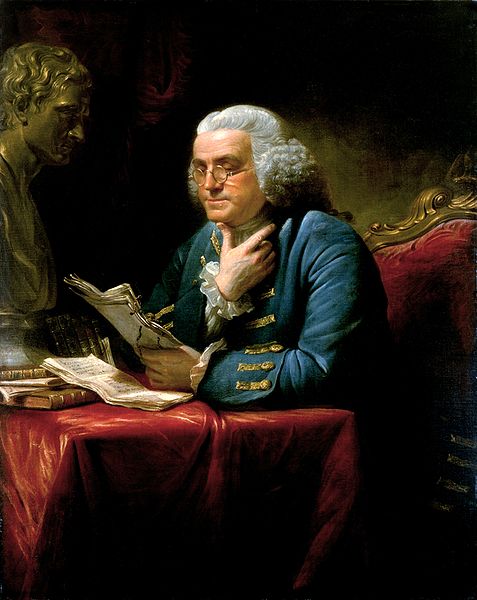
I confess, I'm not particularly a Benjamin Franklin fan. Oh, it's not that I don't like him (because I do), and it's not that I don't think he was a fascinating historical figure (because he was). It's just that, of the Founding Fathers, I happen to have a particular soft spot for John Adams. (The original, that is, not his son.)

But that's just a matter of personal preference -- I'm not knocking Franklin. This Founding Father, who was the oldest delegate at the Constitutional Convention, is rightly remembered not only as a Founding Father -- but as a writer, publisher, inventor, scientist, politician, postmaster, musician, and diplomat, among other duties. He's intriguing for both his myriad accomplishments and his witty personality, making him a figure of fascination both in his own time as well as ours, and in America as well as abroad. My favorite story about Franklin comes from his trip to France, when he traveled to negotiate support for the American Revolutionary War. When he arrived, he found his reputation as a writer and scientist had preceded him. The French admired him, both for his philosophy and his politics -- admired him so much, in fact, that many French people hung his portrait in their own homes. (He'd go on to become "perfectly sick" of having his portrait painted, which he did often at the request of friends.)


You might know Franklin as the inventor of bifocals, the (aptly named) Franklin stove ... and, of course, the lightning rod. (We'll come back to the lightning rod in a bit.) Some of his other experimentations into the fields of science and invention, however, are not always as well-remembered:

-- A frequent traveler, it was Franklin who first proposed that illnesses such as colds and flu may not be caused by exposure to cold and chill air but rather "may possibly be spread by contagion." He noticed his excursions through severe temperatures, suffering cold "sometimes to the extremity only short of freezing," failed to make him sick. He noted that people did, however, often catch cold when spending too much time in close quarters to someone who was already ill, and he became a proponent of good ventilation and fresh air year round.

-- Not only did Franklin recommend exercise as a way to stay in good health, but he was one of the first to put forth the theory that it was more than duration that was important. He suggested measuring exercise not by the length of time it was performed, but rather "by the degree of warmth it produces in the body" -- and by the increase in a person's heart rate.

-- Benjamin Franklin was one of the first people to begin to suspect that there were negative effects from the handling of lead. He began suggesting replacements be made with alternate metals to counteract the "possible" negative effects of lead.

-- He was the inventor of a musical instrument he called the "armonica," which consisted of thirty-seven glass bowls of different sizes attached to a spindle. You played the device the same way bored dinner guests might amuse themselves with their wine glasses -- by pressing on the glass pieces with wet fingers. As goofily fun as it might sound, the armonica proved to be a popular fad: Marie Antoinette took armonica lessons, and music was written for the instrument by both Mozart and Beethoven.

And then, of course, there's my other favorite Franklin story.


Everybody knows about Franklin's famous electrical experiment -- finding a link between lightning and electricity. While many other scientists (like Sir Issac Newton) had suspected a link between the two, Franklin was the first to devise a methodical test to prove that link. Hence, flying a kite with a wire and key attached, hoping to attract a spark.

What's not so well known? Franklin wasn't flying the kite.

It would have looked terrible, had Benjamin Franklin -- a quite respectable figure -- been seen dashing about a field hauling a kite wildly behind him. So he enlisted a little help: his son, William. Yes, it was Franklin's son, and not Franklin himself, who was out in the rain -- and the lightning -- testing the theory.

... well. Family is all about helping each other.


Today, January 17, marks Franklin's 306th birthday. He lived to be eighty-four, and his myriad accomplishments, trades, discoveries, and experiences make him as fascinating a figure as ever. But then again, I may be biased. Much as I love John Adams, I'll always appreciate Benjamin Franklin, first and foremost, as the creator ... of the very first public lending library in America.

(Oh, and don't feel too bad about William Franklin being stuck flying the kite. He was in his twenties at the time -- and he survived the experiment just fine.)


-- Post by Ms. B